
Finding a good vendor is like finding a needle in a haystack, but it’s a non-negotiable step when launching your hair empire. But let’s be honest—some folks look for shortcuts, shelling out cash for hair vendor lists to speed things up.
The catch? Most of these lists are just a collection of random phone numbers tossed together with the finesse of a toddler’s art project. And the rest? Straight-up garbage—or worse, scams designed to part you from your hard-earned cash.
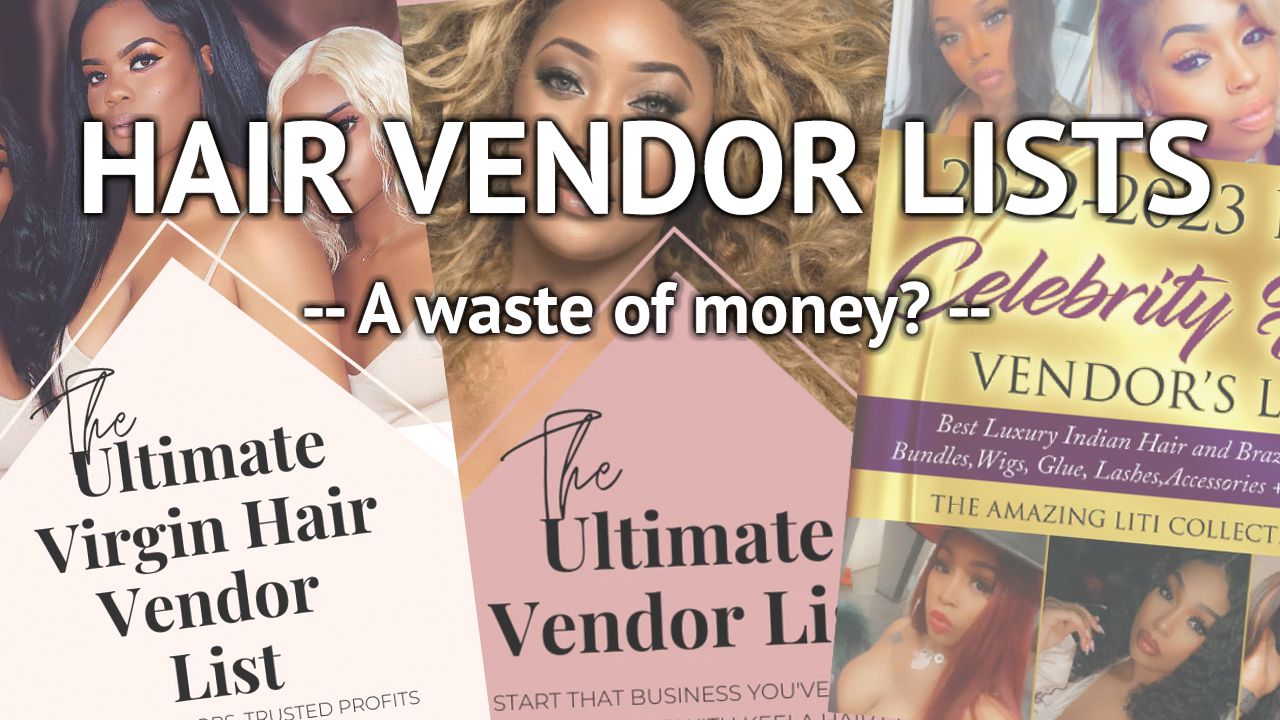
Table of Contents
1 – Ultimate Hair Vendor List Case Study
Let’s look at a few examples to illustrate why you should be cautious about certain hair vendor lists.
1.1 – Free Hair Vendor List: The K-Hair Scam
Take the so-called Free Hair Vendor List by Hair Vendor Review, for example. Right off the bat, K-Hair is the top recommendation—a choice that should scream red flag.
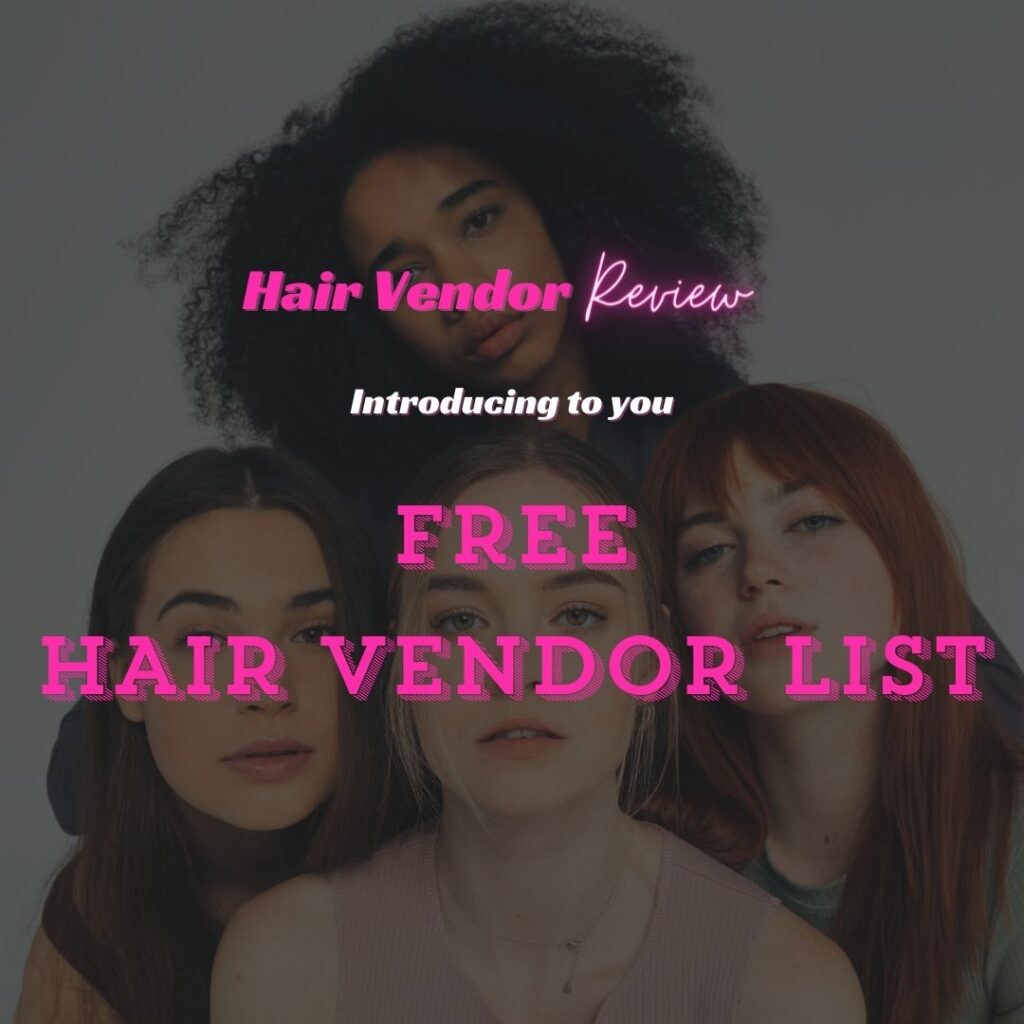
Here’s the deal with K-Hair: it’s a Vietnamese vendor notorious for faking reviews, paying retail clients to spam groups with glowing endorsements in exchange for rebates, and churning out random website articles that somehow recommend… themselves. Even when the topic is about Chinese hair vendors!
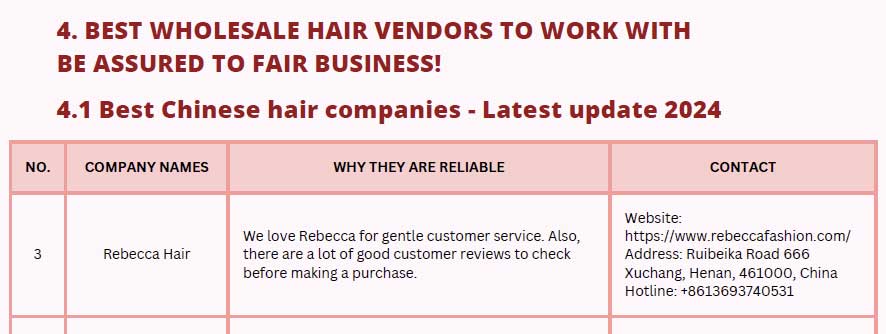
And it gets wilder. Number three on this “best Chinese vendors” list is Rebecca Hair. Yes, Rebecca Hair—the same company famous for selling synthetic hair. Sure, they dabble in human hair extensions, but their sourcing? It’s the same as one of my manufacturer friends, and the quality is paofa (fully stripped cuticle hair)—the absolute bottom-tier of human hair.
Bottom line? This list is a joke, and whoever threw it together clearly knows as much about Chinese hair as I know about rocket science.
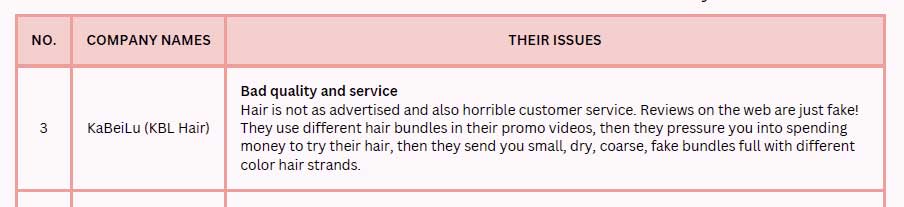
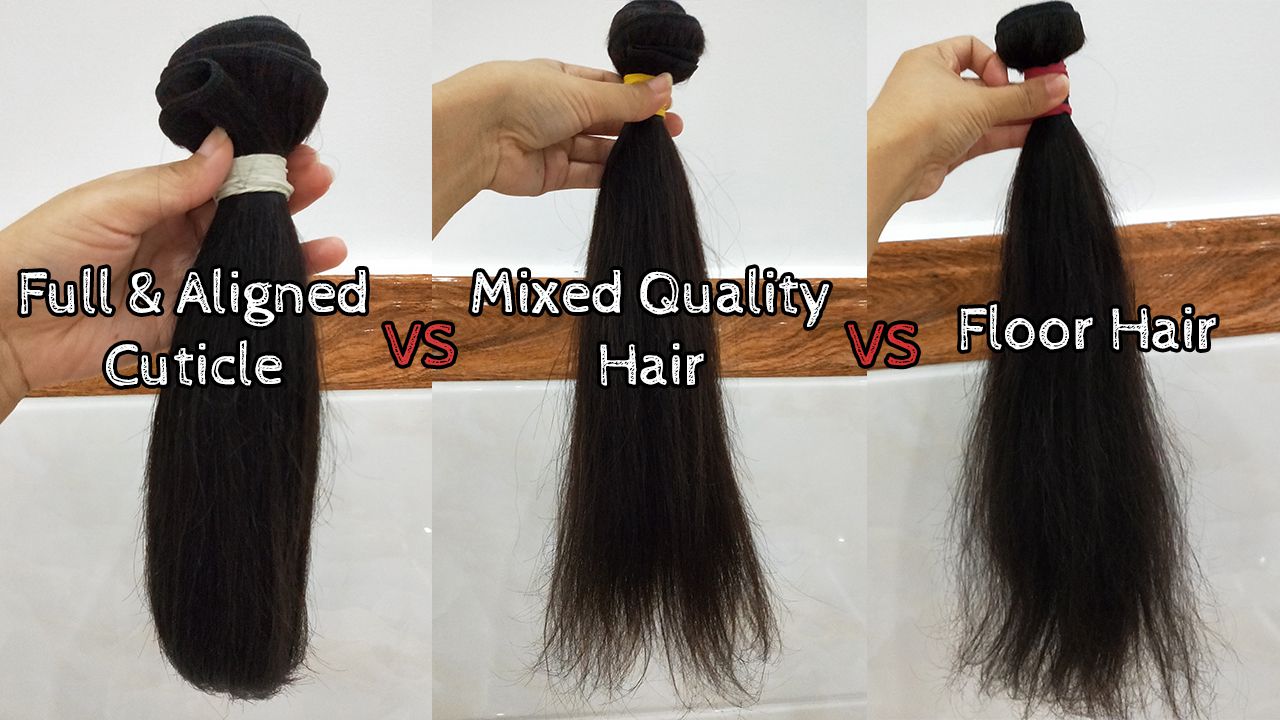
And then there’s KBL, bizarrely featured on their bad vendor list. Let’s break this down. KBL has three main product lines: XR Brazilian, which is a mix of floor hair and donor hair; the Blue Line, which should be donor hair; and the White Line, their fuller, higher-quality version of the Blue Line.
Now, I’m not saying KBL is perfect—they’ve hit some bumps in the road. They’re a big player that’s lost some of their shine, and with their pricing on the higher side, working with them is like stepping in something unpleasant—you’ll need a stick to scrape it off before moving forward. But even so, let’s be real: their hair quality is leagues above Rebecca’s paofa.
The fact that KBL ends up on the bad list while Rebecca Hair somehow makes it onto the “best” Chinese vendors is laughable. It just shows how little thought or expertise went into creating this list.
Something smells a little fishy here. A quick dive into whois.com shows the site is tied to Vietnamese nameservers, which basically means it’s probably hosted in Vietnam. Don’t just take my word for it—feel free to snoop around yourself by clicking this link.

And if that wasn’t enough, check out the footer of every page—it says the site is “powered by tuanha.asia.” Hmm, that sure has a distinctly Vietnamese sound to it, doesn’t it?

Now, putting two and two together—could this entire list have been put together by someone in Vietnam to promote their own business? If that’s the case, then yeah, this list might just be a full-blown scam designed to boost their own company.
1.2 – More Vendor List and Guide Reviews
Some hair vendor lists or guides are written by people who have booked some success. But that said, they’re not the ultimate authority on hair facts. Their success might just be because they got in early (before the 2024 competition kicked in) or because they’ve mastered the art of clever marketing.
Bomb Hair Inc.
The Bomb Hair Inc. guide on How to Start a Hair Business isn’t bad, but it’s a little too basic to get you past the “I’m starting a business!” phase for our taste. But here’s something she got wrong.
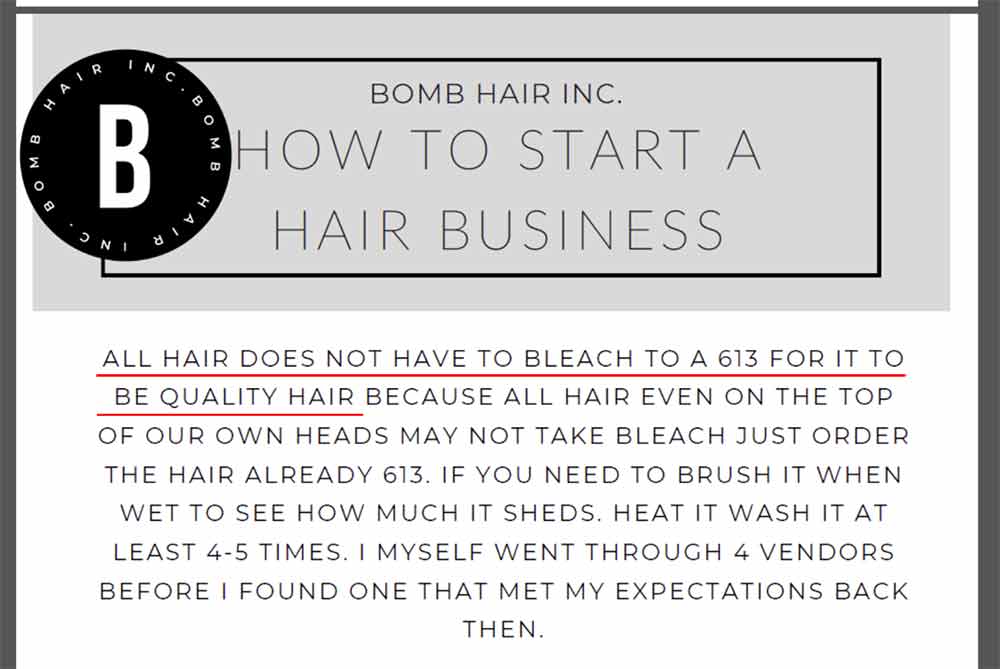
If Asian hair doesn’t bleach to #613, it usually means the hair wasn’t sourced properly, and shortcuts were taken. Maybe the girl’s hair was already colored, or the manufacturer processed and dyed it to an even black. Here’s the thing: top-quality hair should bleach to #613. But remember, it’s a marathon, not a sprint. The goal is to get it to #613 healthily, not just quickly.
Cracking The Code – Hair Vendor Secrets
This book is a classic example of someone who’s been in the hair industry for years but still manages to get things so wrong. Let’s break it down:
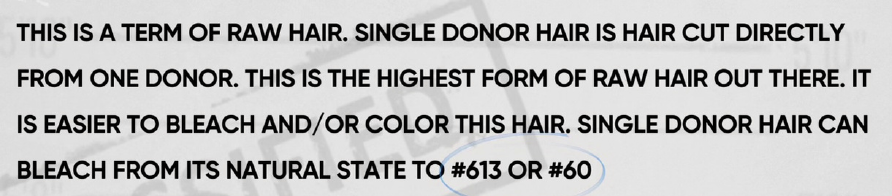
First, the single-donor myth. If hair from one ponytail can bleach to #60, and another can do the same, combining them doesn’t magically ruin the ability to bleach to #60. That’s basic logic. And the reality is, if you buy 100 bundles of 20″ hair, they’ll all have equally full ends and weigh about 100g each. This consistency isn’t magic—it’s the result of carefully blending hair from different donors to control the fullness ratio and weight.
This is a common misconception about hair. If hair from one ponytail can bleach to #60, and you combine it with another ponytail that can bleach to #60, the combined thing can still bleach to #60. Furthermore, if you’d buy a 100 20″ bundles, they’re all going to be with equally full ends, and all around 100g. It’s because the fullness ratio and the weight are controlled, and that’s done by combining hair from different donors.
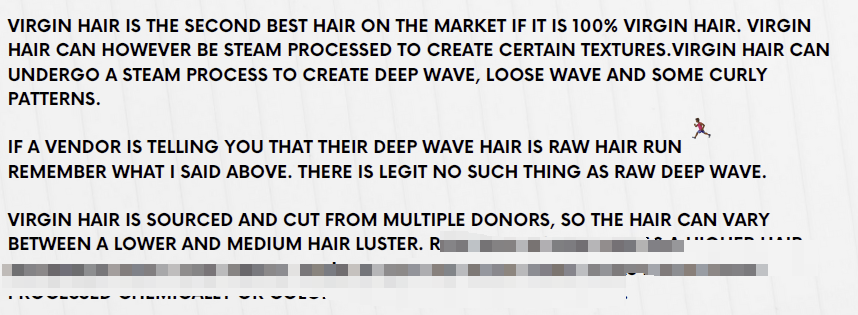
Now, her definition of virgin hair: multiple donors and the “second best” on the market. Let’s clarify—single-donor hair is largely a myth, and both raw and virgin hair are multi-donor. Steam-styling doesn’t affect the quality either. The issue isn’t the method; it’s the misunderstanding of what truly impacts hair quality.
Speaking of quality, it’s not steam or multiple donors that ruin it—it’s poor sourcing and shortcuts during production. When you’re dealing with low-quality hair, you’re talking about floor hair. Scrap hair? Sure, it has an ick factor, but it’s simply the majority of hair that doesn’t meet the high price tag of premium strands.
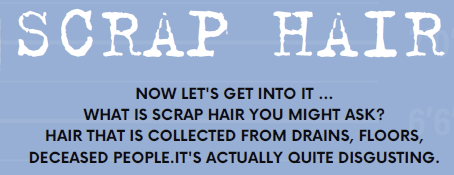
And let’s be real—she paints scrap hair as horrendous while probably not batting an eye at eating a sausage now and then. (You know, the kind made with intestinal casing.) Perspective, right?
1.3 – From Bad to Worse: The Vendor List Disaster
There’s zero effort to distinguish between raw hair, processed floor hair, or anything in between. Honestly, at this point, they might as well throw a synthetic hair vendor onto the list and call it a day.
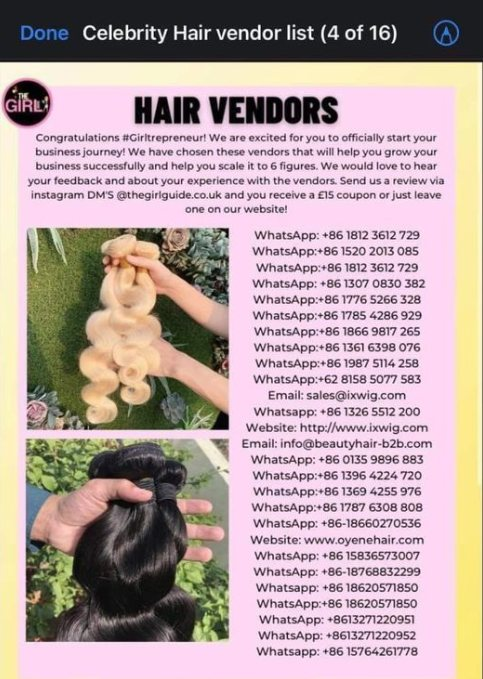
And let’s take the laziness up a notch—just slap together a list of random phone numbers without even mentioning names. Seriously, how are you supposed to know where to even begin with this Celebrity Hair Vendor List?
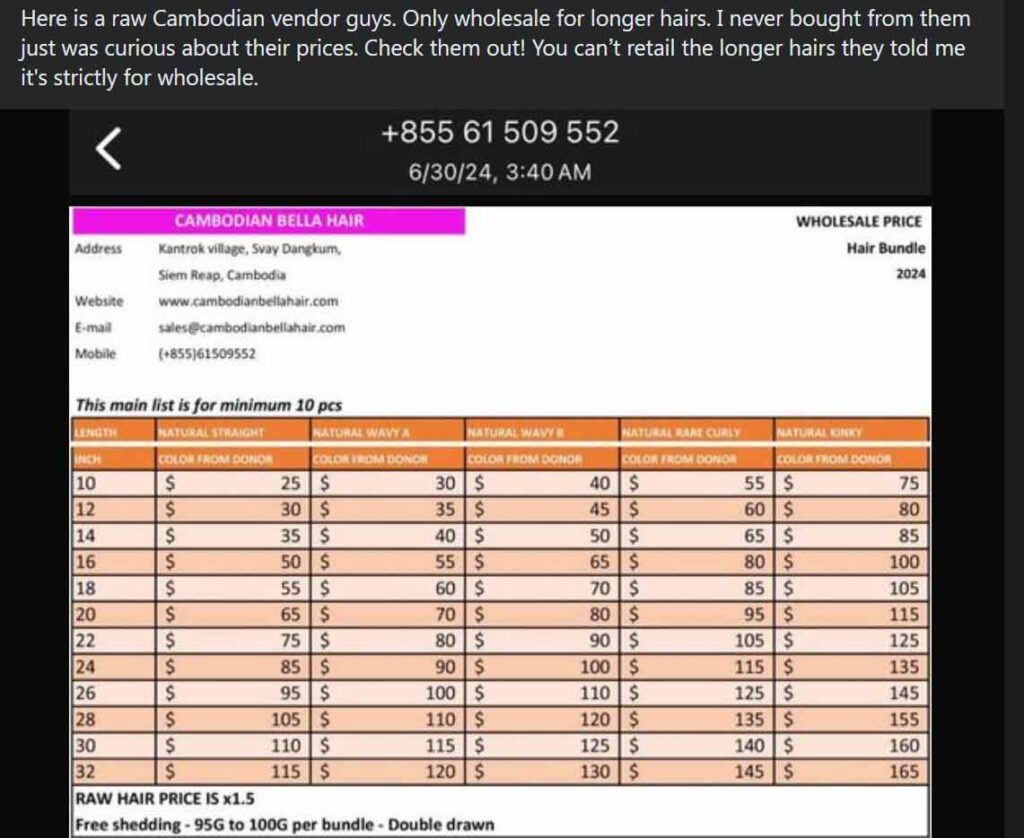
Or better yet, let’s make it even worse: “Here’s a vendor I stumbled across, but I haven’t tested them. Basically, I just saved you a Google search. You’re welcome!”
1.4 – VIP Sister Hair – How Did They Make the List?
Let’s take a look at another list. Ideal Hair Arts and BBoss? Yep, KBL sister companies. Haiyi Hair? They’re a manufacturer focusing on the white women’s market, so they’re kind of an oddball on this list. But the real crime here? VIP Sister Hair.
Confessions of a Former VIP Sister
I used to be a sales manager at VIP Sister, in case you didn’t know. Need more proof? Here’s an unlisted video from our YouTube channel, all the way back in 2017.
Back in the early days, we actually had raw hair at VIP Sister. But, as we all know, the boss needed to make serious money—enough to fill a bathtub with cash and do the Scrooge McDuck thing. Here’s the twist, though: there’s way more profit in passing off lower-quality hair as raw, and that’s exactly the path they chose. No more top-tier hair, just a whole lot of false marketing. Even their Shunfa (processed floor hair) was marked up way beyond what we charged for better quality.
Long story short, I quit, and things got ugly. The boss went after me, accusing me of stealing clients—though, to be honest, I did abandon all my clients (which was dumb, I know). So, I took it upon myself to go on a “revenge tour,” teaching people how to spot these shady practices. Basically, I was out there spreading evil in kindness.
They eventually downsized, and while I could ramble on about this for hours, it really boils down to this: They’re overpriced, the quality isn’t impressive, and they absolutely do not belong on any “good” hair vendor list.
But let’s keep going—it’s a mixed bag of vendors with wildly varying quality. Sure, I can’t vouch that the KBL sister companies deal exclusively in 100% unprocessed hair, but they’re at least in the ballpark. VIP Sister, on the other hand? Nowhere near.
2 – What Should You Really Be Looking For?
Chasing “good” hair? Well, “good” is one of those annoyingly subjective words. Think of it like this: a Lamborghini is a great sports car, but not exactly practical for picking up your kids from soccer practice. What’s good all depends on your specific goals.
Let’s say your goal is hair that can bleach beautifully to #613 without falling apart. Now we’re talking specifics. Test it. If the hair fries or doesn’t quite make it to #613, it’s not the quality you need—it’s just not good for your purpose.
So, the first step in finding your ultimate vendor? Define your terms. Start by asking yourself the big question: “Am I after the absolute best quality hair and willing to pay a premium for it? Or do I need something more budget-friendly, like processed floor hair?”
You could label this as the classic “raw vs. virgin” debate, but here’s the catch: the “raw” label is overhyped and doesn’t always equal high-end hair. Meanwhile, “virgin” is so overused it covers everything from top-shelf hair to the cheapest processed bundles, leaving you in a fog of confusion.
2.1 – High-End Hair: What to Look For
When it comes to high-end hair, the gold standard is raw, 100% unprocessed hair. This means it hasn’t been colored or chemically altered, making it ideal for bleaching to light blonde shades like #613 or #60. To confirm this, you’ll want the hair to pass the acetone test—this proves it’s uncolored and most likely unprocessed.
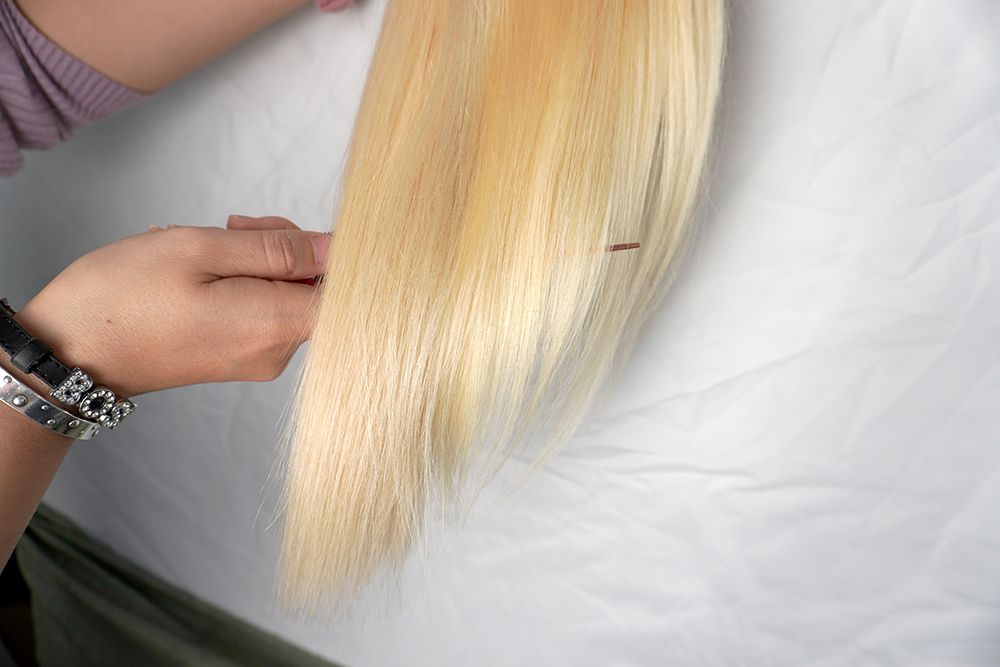
A visual clue? Take a look at pictures of these #613 straight hair bundles. High-quality #613 made from genuine raw hair will have a slightly coarse texture and a wheat-like shade. In contrast, anything pre-processed will appear smoother and more yellowish. See the picture below for reference.
That said, there’s a catch—hair with 100% intact cuticles isn’t ideal for curly textures. Why? Fully intact cuticles can make curly hair harder to maintain. Some degree of cuticle stripping can actually be beneficial to reduce snags and make curly hair easier to handle. Stripping some of the cuticles can actually help the hair hold a curl better.
At Bossique, we focus on top-quality hair that’s perfect for bleaching, but we don’t claim to be the go-to for curly textures. If you’re looking to stock up on 3A, 3B, 4A, or similar curl patterns, you can get away with slightly lower-quality hair (though don’t expect it to be cheaper). Plus, it doesn’t need to ace the acetone test. And let’s be honest—bleaching curly hair? That’s doing things backward anyway.
While Urban Chic offers hair material similar to ours, the difference is in the details—our hair comes with thicker ends. Translation? You’re getting more long hair, less short hair, and way fewer complaints—all at the same price. That fullness ratio is definitely something to keep in mind.
-
Product on sale
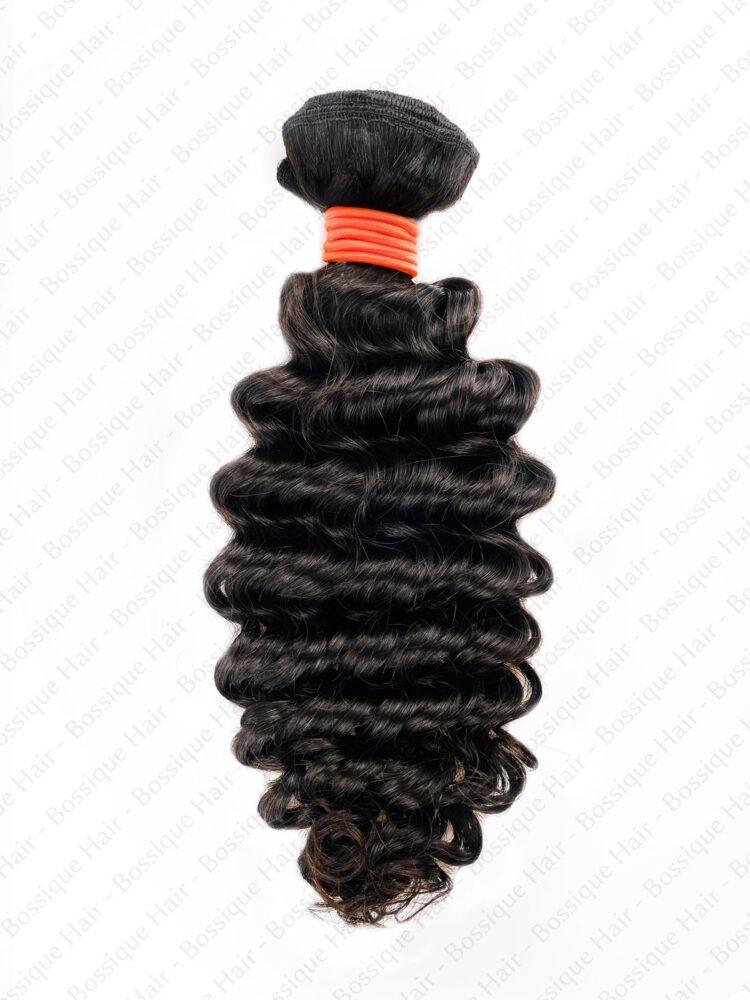 Orange Line Curly BundlesFrom $35.80
 -
Product on sale
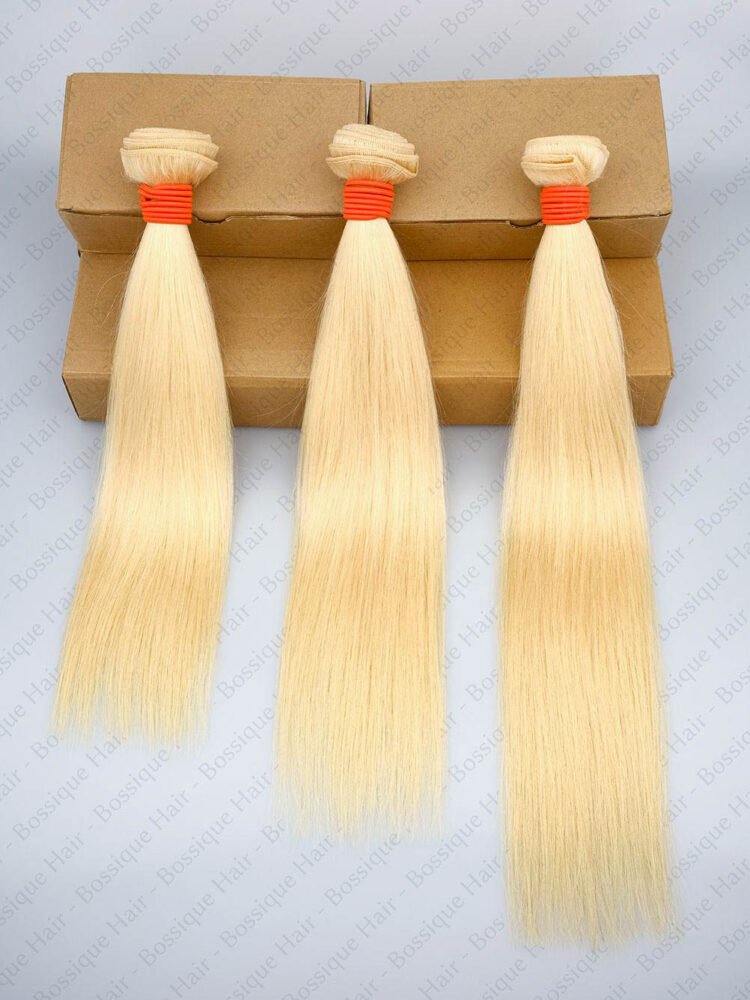 Orange Line 613 Straight BundlesFrom $44.10
 -
Product on sale
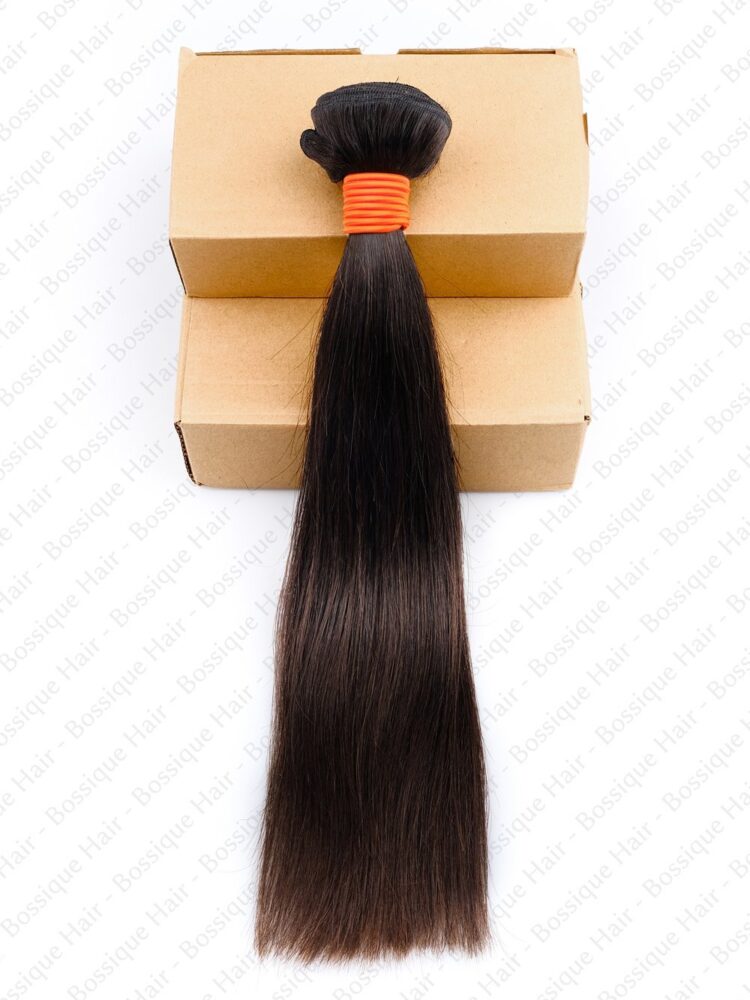 Orange Line Straight BundlesFrom $33.80
2.2 – Affordable Hair: What You Need to Know
Let’s be honest—everyone’s selling “Virgin Hair” these days, which usually translates to floor hair aligned with a non-remy-to-remy machine, dunked in chemicals, and dyed to an even shade of black. It’s not our main focus because it’s all so generic. You can’t stand out with that like we do with our Orange Line extensions.
That said, processing damages hair, and thicker hair material handles the abuse far better. That’s why we source slightly thicker hair material with our Black Line bundles. It survives harsh treatments while staying elastic, meaning less damage, less dryness, less snagging, and—most importantly—a longer lifespan.
For 2024, the price for 30-inch bundles of this quality typically runs $60–$75. With us, though, it’s considerably less than most competitors—especially when you factor in the fullness ratio you’re getting.
And let’s talk about that super silky, bone-straight hair everyone loves. Beneath all that silicone coating, it’s often garbage. Indian hair, for example, isn’t thick enough to withstand heavy processing, while Chinese processing tech is top-tier. If you’re after affordable hair with a decent lifespan, China is definitely an origin worth considering.
But keep this in mind: damaged hair equals dry hair, and dry hair is the root of all evil. It sheds more, tangles easily, and doesn’t last. To counter this, a proper moisturizing routine is crucial.
- Little damage? Conditioner will do the trick.
- More damage? Add oil to lock in moisture.
- A lot of damage? You might need to rely on silicone-based products to squeeze out every last bit of lifespan.
Choose wisely, treat it right, and you’ll get the most out of your affordable hair investments.
-
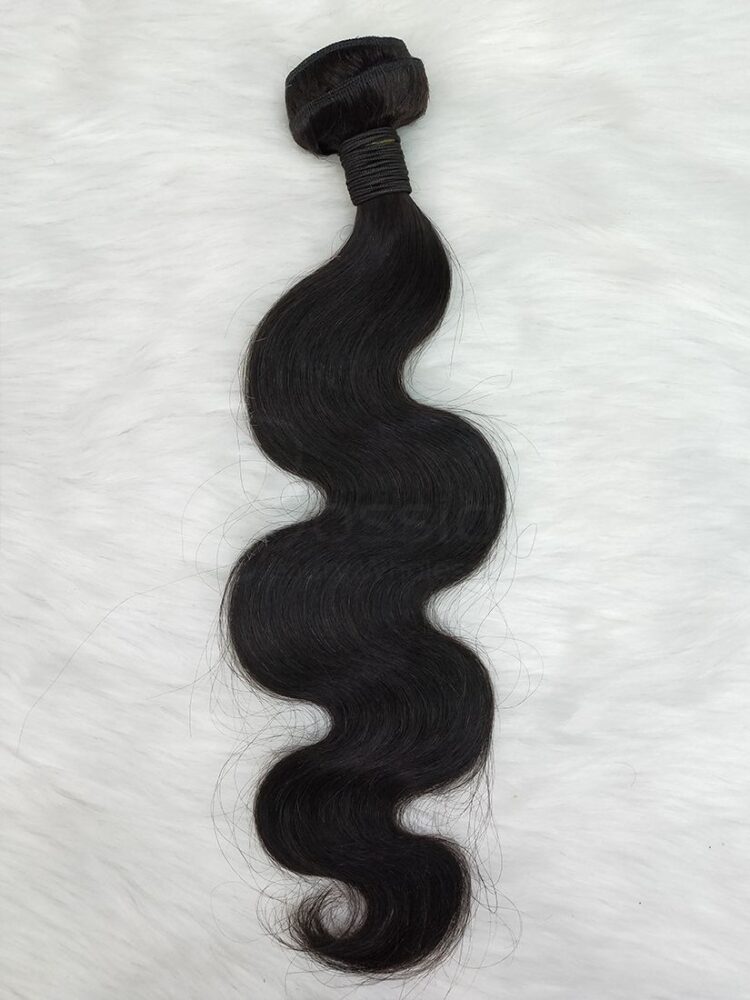 Black Line Body Wave Hair ExtensionsFrom $18.60
 -
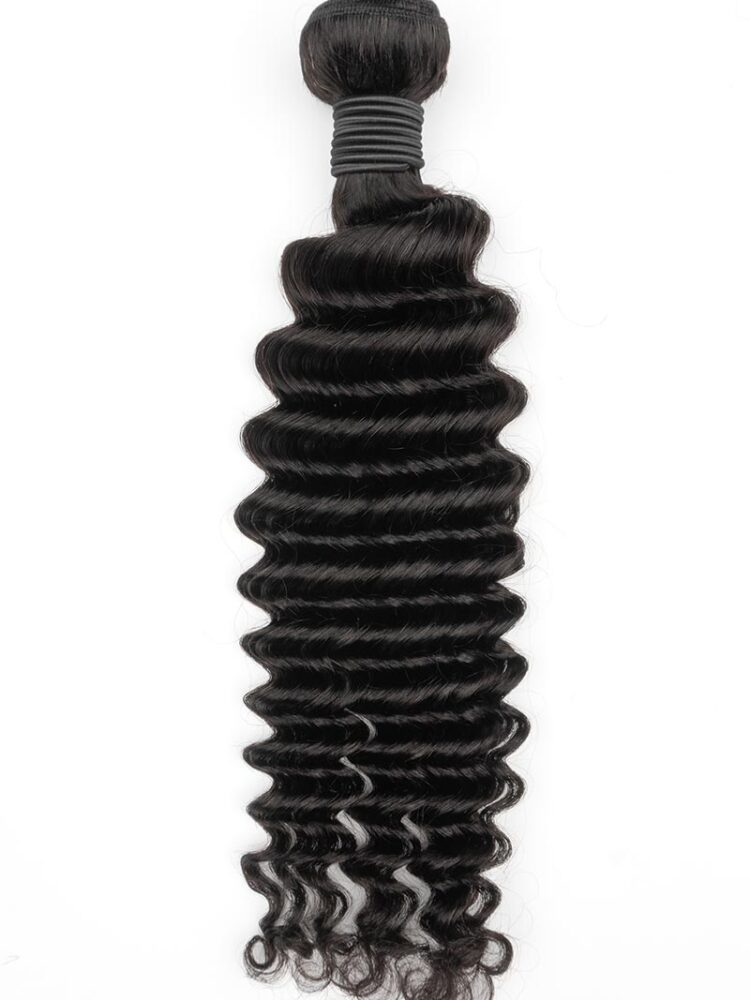 Black Line Deep Wave Hair ExtensionsFrom $24.50
 -
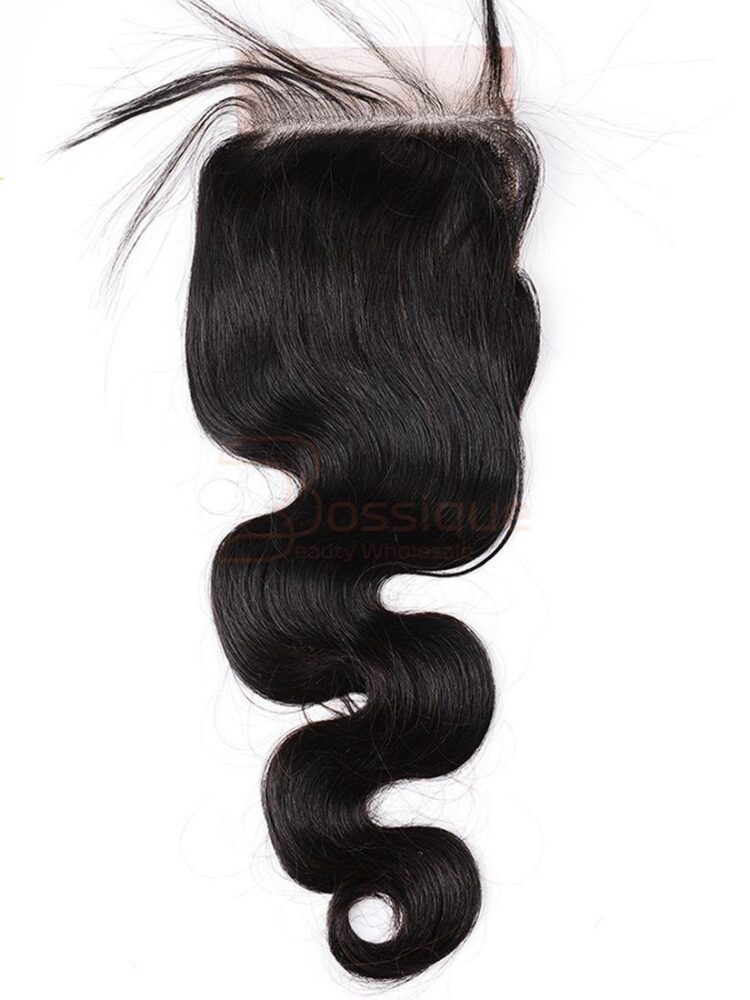 Black Line Body Wave HD Lace Closure | 4×4 5×5 6×6 Swiss HD LaceFrom $35.70
3 – People Don’t Want to Share Their Real Hair Vendor
Picture this: you’re a hair vendor pulling in five figures a month, your hair’s the talk of the town, and everyone wants to know where you’re getting it from. But for some inexplicable reason, you lose all your common sense (maybe in some freak accident), and you think it’s a great idea to sell the contact info of the vendor that’s making you that five-figure income—for just $500.
Fast forward, the list leaks, and suddenly, three Facebook groups with 10k+ members each now have your vendor’s info for free. So, congrats, you pocketed $500, but how much do you think you’ve lost in potential sales?
So, do you honestly think any successful vendor would willingly sell their real vendor?
So what you end up with are less successful—or downright unsuccessful—people just trying to make a quick buck. But if they’ve got that perfect vendor, why haven’t they booked success themselves? Here’s some food for thought: finding that one “magic” vendor doesn’t guarantee success.
Success is really about convincing people to buy your product—and that’s called marketing. Good marketing can make you rich. That one awesome vendor? Just a tiny tool in the big picture of success. Yet, oddly enough, you’ll find way more people obsessing over finding the “perfect” vendor and selling vendor lists than you’ll ever see putting together solid guides on hair extension marketing.
4 – The Ideal Hair Vendor List: What It Should Include
We’re not totally against hair vendor lists, but let’s face it—they could be way better. Instead of being a vague collection of conclusions, these lists should share detailed, actionable data, like this:
4.1 – About the Seller
You should know a thing or two about the seller before you trust their recommendations. Is she genuinely an expert, or just claiming to be? Does she back up her advice with solid information, or is she just spitting out opinions? Does she have a weird aversion to cuticles and consider raw hair too high maintenance? What’s her focus—top-quality hair or something more budget-friendly? How does she determine if hair is truly good quality? And does she even care about customer service, or is it all about the product?
Any decent vendor list should offer some of these insights to help you figure out whether the list creator is someone you can actually trust. Without that context, it’s hard to know if the recommendations are reliable or just random guesses.
4.2 – About the Vendor
- Vendor’s Name: Pretty basic, but essential.
- Tested Quality: What type of hair was tested? (Click here for a breakdown of the different hair qualities.)
- Salesperson Info: Let’s face it, some sales reps have been known to steal clients—so it’s good to know who you’re dealing with.
- Price List (Optional): A price list can help, but remember—quality matters more than scoring a bargain. Paying a bit more for better hair is worth it.
4.3 – About the Testing
The tests need to be standardized across the community performing them. Testing hair requires some basic knowledge, and not all tests are created equal. For example, bleaching hair for 30 minutes and seeing how far it gets isn’t the best approach. What really matters is whether the hair can healthily reach a particular color—meaning you bleach until the hair loses elasticity.
Methodology
- Test 1: Description + result
- Test 2: Description + result
- Test XYZ: Description + result
With these standardized tests, you can compare results across vendors to create a fair and transparent evaluation. Want to make it even better? Add a scoring system—stars, numbers, or some creative way to make the results easier for buyers to interpret.
The goal? To create vendor lists that actually help buyers make informed decisions. After all, if we’re going to do this, let’s do it right.
Good tests to determine whether it’s quality hair, would be testing for the hair’s elasticity, or doing the acetone test.
5 – Key Points to Keep in Mind
And if there’s anything I missed, here are some key points that will give you even more insight into what to look for when finding a vendor—and why you should be cautious with certain vendor lists.
5.1 – Search for What You Want, Not What Others Like
Vendor lists are like the “best of” playlists on Spotify—everyone’s got their own favorite tracks. Don’t get swept up in someone else’s hype. What one person loves could be your worst nightmare. Instead, make a list of your priorities, and find vendors who match them, not the ones who made it to someone else’s list because they’re trendy or popular.
5.2 – Vendor Lists Lack Important Details
Ever looked at a vendor list and thought, “This is it! The answer to all my hair problems”? Only to find out it’s just a random list of names with zero explanation of what actually makes them “good”? Vendor lists are like mystery boxes—filled with surprises, but not the good kind. You’ll end up testing each vendor to figure out if they’re even remotely a good fit, making the list almost useless. A little more info upfront would save you a lot of headaches.
5.3 – Reviewers Aren’t Always Experts
Just because someone liked their last set of extensions doesn’t mean they’ve cracked the hair code. We’ve all been there—falling for something that seemed great at first but turned out to be a disaster. Reviews are often based on past experiences, not actual expertise. If you liked how a set of extensions behaved, that’s nice. But it doesn’t mean they were top-tier—it just means they did what you expected them to do. There’s a big difference.
5.4 – Testing Vendors Takes Time and Money
Finding the right vendor is like dating—it takes time, effort, and money. Sure, you can test 10 vendors at $50 a pop, but before you know it, you’ve spent $500 and still don’t have a match. So while buying a $50 vendor list might seem like a deal, it’s basically skipping straight to the “I love you” part without actually getting to know them. Might as well skip the list, make mistakes, learn from them, figure out what really works for you, and set yourself up for success in the long run—just like a healthy relationship, but with better hair.
5.5 – Vendor Lists Are Often Incomplete and Unreliable
Think vendor lists are the answer to all your problems? Think again. Most of these lists are thrown together by people who don’t even know the difference between remy and raw hair. What you end up with is a generic list of names with zero context, leaving you to do all the hard work yourself. So while the list might look impressive, you’re still left guessing. It’s like buying a cookbook that doesn’t include any recipes.
5.6 – Unfair Generalizations in Vendor Lists
Vendor lists often make the mistake of lumping everything together, even when one vendor offers multiple types of hair. For example, one bad review of a batch of “Virgin” hair could lead to the entire brand being blacklisted, even though they might have other high-quality options. It’s like judging an entire restaurant based on one bad dish. Don’t let these unfair generalizations fool you—take the time to know what’s really on offer.
5.7 – The Importance of Quality Testing
Just because a vendor made it onto a list doesn’t mean their hair is actually worth your time. Testing is where the magic happens—and, unfortunately, where most vendor lists fail. A quick scan won’t cut it. If you really want to know if a vendor is up to snuff, you need to test their hair for yourself. It’s the only way to separate the wheat from the chaff and avoid wasting your hard-earned cash.
Our articles are created to help you make smarter purchases and save money. If you’ve found them helpful, we’d greatly appreciate it if you shared them with your friends, family, or in your favorite online groups. Your support helps us reach more people and keep producing high-quality content.
Have questions? Contact us directly on WhatsApp or iMessage at +86 135 3369 3283, or email me at cristina@bossique.com. Many of our articles originate from discussions on our Facebook page. We’d love to hear from you!
Finding the Best Vendors: A Quest as Random as This Heading
Every time I scroll through Facebook and see someone looking for a hair vendor list, I can’t help but hear the Pokémon theme song.
I wanna find the very best,
Like no one ever has,
To grab them is my real test,
To trust them is my task.
I will scroll through every group,
Searching far and wide,
Hoping vendors get the game,
With hair that’s truly prime.
Hair Extensions Cheat Sheet
Why Are Most Hair Vendor Lists a Waste of Money?
Most hair vendor lists are like overpriced junk mail – thrown together with zero quality control. They often feature random vendors who haven’t been properly vetted, leaving you to wonder if you’re getting top-notch products or just another scam artist trying to boost their sales. Instead of offering solid, actionable advice, these lists are more like a game of “guess who” when it comes to quality, customer service, and reliability. If you want real value, skip the lists and do your homework, or find sources that actually offer tested, trustworthy information.
How Can I Spot a Reliable Hair Vendor List?
A reliable hair vendor list should be more than just a name and phone number – it should tell you the real story. Look for lists that go beyond the basics and dive into details like the types of hair tested, results from bleach or elasticity tests, and what sets the vendor apart from the rest. Bonus points if the list gives you insight into the seller behind it – are they seasoned pros who actually know their hair? If the list is light on substance, chances are, it’s not worth your time or money.
What Should I Look for When Choosing a Hair Vendor?
When choosing a hair vendor, prioritize quality and transparency. First, define your goals: Are you after premium hair that can bleach like a dream, or are you keeping an eye on your budget? For top-tier options, look for raw, unprocessed bundles that pass crucial tests like the acetone test. If you’re going for a more affordable option, check how well the hair holds up to processing and daily wear. And don’t forget about customer service – great quality isn’t just about the hair itself, it’s about a seamless buying experience too.
Why Do Some Vendors Not Want to Share Their Real Supplier Information?
Successful vendors aren’t quick to hand over their supplier details because those relationships are their secret sauce. If they sell this information, they risk losing their competitive edge—other vendors could swoop in and go directly to the same manufacturer, undercutting their prices. While selling supplier info might seem like an easy way to make a quick buck, it’s usually a bad move. In the long run, leaking this kind of intel can lead to serious revenue losses and damage their entire business model.
1 thought on “The Not-So-Ultimate Hair Vendor Lists”
Comments are closed.