
Almost all human hair extensions are sourced from Asia or India. By default, this raw material is naturally black or dark brown.
So, if the hair is already dark, why do factories spend money and chemicals dyeing it to a uniform off-black 1B or jet-black Color 1?
The answer is that the dye isn’t just a color choice—it is a visual hint to how the hair was collected and processed. A minor color touch-up on premium donor hair won’t ruin its quality, but the heavy, dark dyes required to hide cheap “floor hair” will completely destroy its ability to bleach.
Before we reveal exactly what factories are hiding in those uniform bundles, let’s quickly define what these color codes actually mean.
Inside This Article
What is “Natural Color” Hair Material?
“Natural color” simply means the hair has not been exposed to dye. Since most hair extension material comes from Asia, it’s important to remember there are 4.7 billion Asians, each with a slightly different shade of black. The average natural color in China sits around a #1B. My own natural hair is darker than average and sits closer to a true #1, while my two-year-old son’s hair sits closer to a #2.
What all these variations of natural color hair share is a typical red or brown glow under bright light. These are the natural warm undertones.
Understanding Jet-Black (Color 1) vs. Off-Black (Color 1B)
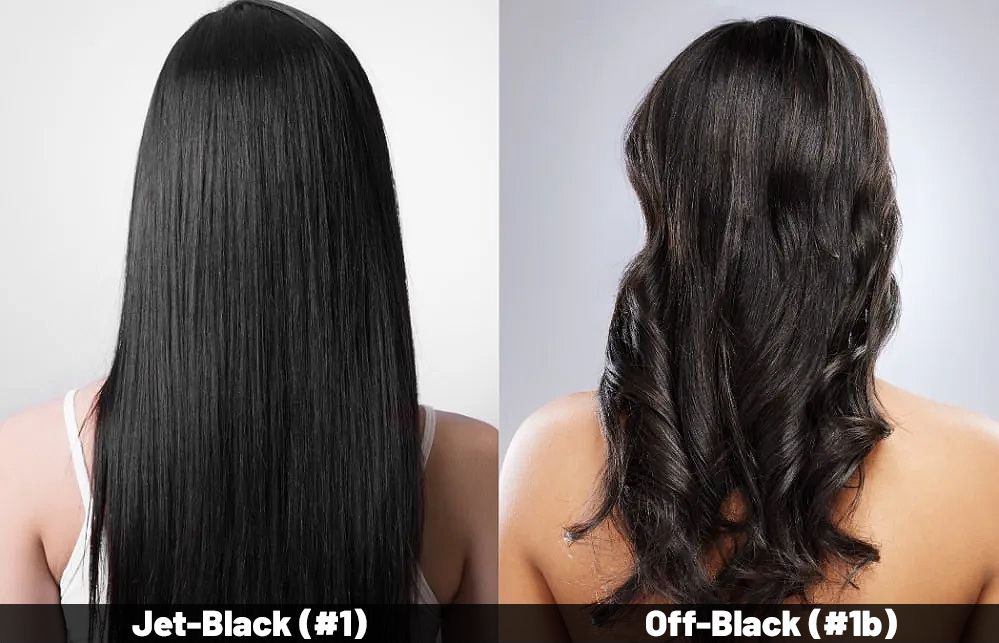
Jet-black Color 1 hair characteristics are simple: it is the absolute darkest shade on the color ring. While human hair can grow this dark naturally (as my own hair does), if a vendor’s entire stock is a perfectly uniform Color 1, it is a red flag. Natural donor hair simply doesn’t have that level of consistency across a whole batch.
Off-black 1B hair sits much closer to the average natural hair color we have in China. However, because natural hair isn’t perfectly consistent, a batch that is consistently #1B is typically processed. Floor hair, for example, is collected from many women, resulting in a chaotic mixture of Color #1, #1B, and #2 strands. That kind of mixed hair can’t be sold as-is, so factories use a dark dye to cover up the inconsistencies and create pure-looking bundles.
While natural color hair has very strong warm undertones, dyed jet-black and dyed off-black bundles lose that warmth, replacing it with a cooler, artificial base (particularly the jet-black).
Because of this, the color itself is a strong indicator of hair quality. However, it’s not your only indication. The chemical processing required to strip and dye this floor hair definitely leaves its own mark, altering the structure and thinning out the natural strands.

What is Color #2 Hair? (Dark Brown)
Color #2 is a natural dark brown that looks black indoors but reveals strong red undertones under sunlight. While some Asian women simply grow this naturally lighter shade, it also happens when natural black hair gets ‘sun-kissed,’ gently fading the ends closer to a #2 over time.
But that said, too much sun exposure isn’t particularly great for the quality of your extensions—especially when it isn’t actually sun-kissed, but is just old dye that the donor eventually grew out.
Despite it being a beautiful shade, finding true, unprocessed #2 bundles or lace products in the Chinese wholesale market is incredibly rare.
This comes down to inventory. Your hair supplier needs to provide color-matched bundles and closures for an install. You can imagine how it goes: when packing your order for 16″, 18″, and 20″ bundles plus a 16″ closure, the worker grabs the products. If the 18″ bundle turns out to be closer to a #2, they replace it with a #1B one so the set matches. Because of this, they slowly end up with a bunch of #2 bundles that are hard to match… especially when the majority of all closures are made with #1B hair material. So, some factories will just dye those #2 bundles to a darker shade and be done with it.
However, #2 material has a tiny advantage when bleaching to light blondes. While minor, it has the head start of having less melanin to strip. So, manufacturers can typically pick the lighter material to be bleached.
The Manufacturing Reality: Donor Hair vs. Floor Hair
If Asian and Indian hair is naturally dark, why do factories dye it? The answer comes down to how the hair was collected. The hair market is divided into two main categories: Floor Hair and Donor Hair. Both categories get colored, but for completely different reasons and with vastly different chemical limits.
Floor Hair: The Affordable 1B Standard
If your bundles are highly affordable (let’s say $70 for 30″ bundles), it’s safe to say they are made with floor hair. If your “virgin” bundles fall into this price range, there is very little virgin about them.
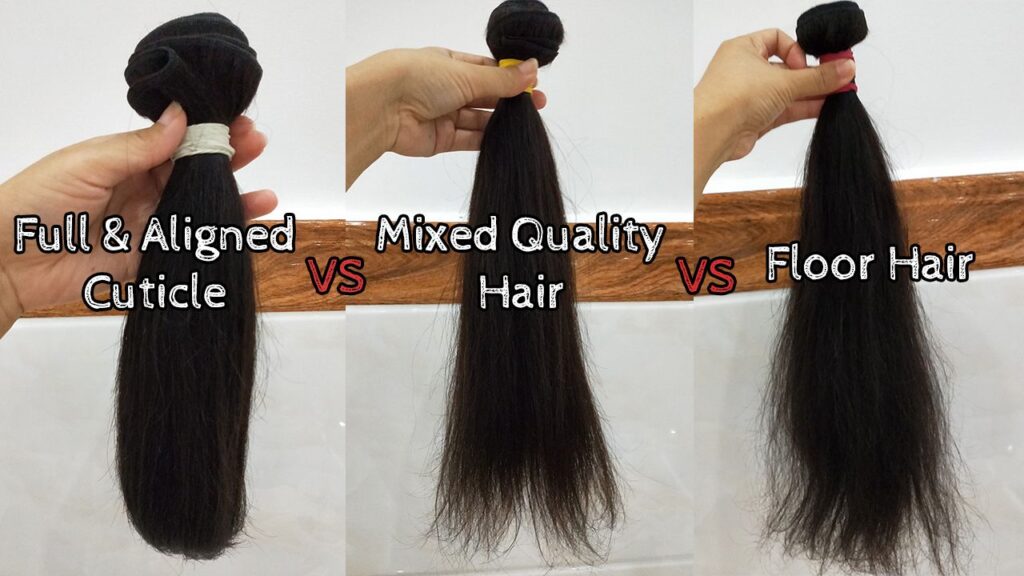
A single bundle could easily contain hair from a hundred different people, each with their own unique shade of black—basically a mix of Color #1, #1B, and #2. Because the cuticles are mixed, floor hair must be chemically processed to remove them. The typical chemical used for this is hydrochloric acid. While not a bleaching agent, a side effect of this acid bath is that it partially strips the hair’s natural melanin. And since the bundle contains hair from a hundred different donors, the strands don’t all react to the acid the same way. That’s how you end up with ‘red filler strands,’ which become clearly visible under certain lighting conditions.

Because this leaves the factory with a chaotic mixture of many different black shades, they have to color the bundles. The only way to cover up inconsistencies in an average #1B batch is to go darker. As a result, factories typically tint the entire batch slightly darker than a true #1B—often pushing it toward a jet-black Color 1—even though it still gets sold under the #1B label.
Is this bad hair? No. It is a reliable, affordable performer in its category; it just shouldn’t be judged by raw hair standards. As long as it is sold honestly, with its natural 6-to-12-month lifespan and a bleaching limit of #27 (honey blonde) kept in mind, you know exactly what you are paying for.
Donor Hair: Pure Natural Color
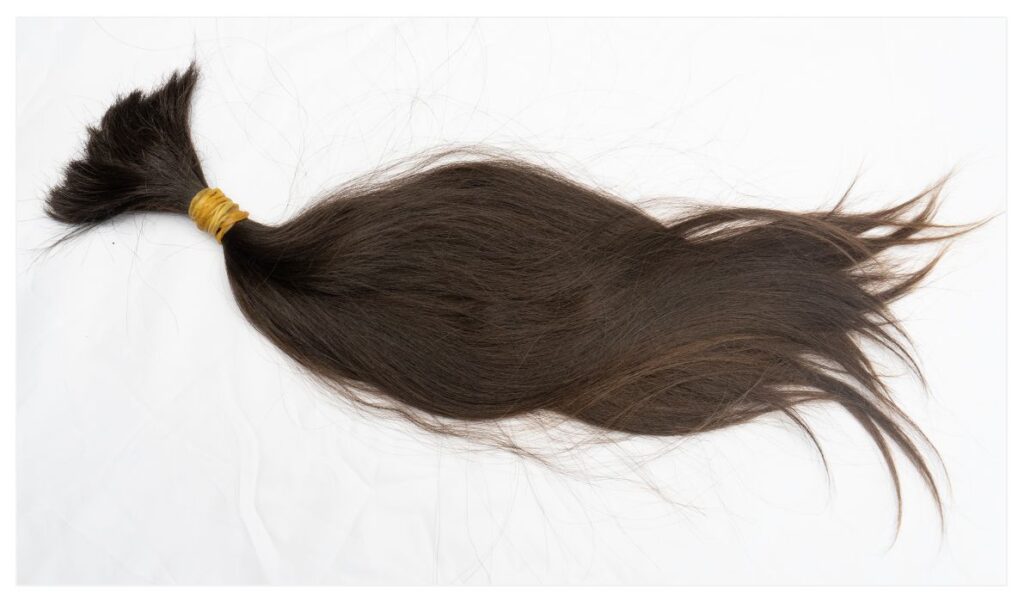
Donor hair is cut directly from a person’s head, meaning the cuticles are naturally aligned. Because it skips the harsh acid baths used on floor hair, true donor hair retains its natural strength and feels noticeably coarser and thicker than processed hair.
Donor hair naturally comes in shades of #1, #1B, and #2. But does donor hair ever get colored? Yes—but it’s typically a light touch-up.
Why does it need a touch-up? First, we need to let go of the “single donor” myth. Manufacturers combine hair from multiple donors to reach a consistent bundle weight (95-100g) and a specific fullness ratio (how thick the ends are). Depending on a factory’s sourcing practices, some bundles contain a much higher donor count than others. Mixing more donors naturally introduces more color variations—or impurities. Factories apply a light color touch-up to mask these mismatched shades and create a consistent-looking bundle.
So why not strictly control the donor count? It comes down to time and money. Not every donor provides 100% healthy, untouched hair. In fact, many women have dyed their hair at some point in their lives, meaning the raw material itself is often already color-altered. When a factory is working with this average-tier raw hair, it simply isn’t worth the extra labor costs to meticulously match ponytails. They just blend it, dye it to cover the inconsistencies, and move on.
Second, as we established earlier, it comes down to matching inventory. Because the industry standard for closures is #1B, factories are often forced to lightly tint their natural #2 donor bundles just to make sure a client’s complete set matches perfectly. Furthermore, when end-users are choosing between 1B and 1 hair colors, the market overwhelmingly prefers darker, uniform bundles. To meet that demand and prevent dead stock, factories lightly color the hair to a consistent #1B.
To solve this, they lightly color the #2 bundles to a uniform #1B so they become easier to sell.
The Reality Check
Whether a factory uses a dark dye on floor hair to cover up a chaotic mix, or a light tint on donor hair to match closures, most bundles on the market have been colored to some degree. Because cheap floor hair usually ends up stark, dark, and perfectly consistent, while higher-quality hair retains natural variation between bundles, you can actually use color consistency as a visual indicator of quality when evaluating natural vs processed hair.
But as you can see, factory processing isn’t a simple “yes or no”—it is a spectrum. And because artificial dye is the biggest roadblock to lifting hair, knowing where your bundles sit on that spectrum dictates exactly what to expect when you finally bleach them.
The Bleachability Truth: How Far Can You Lift It?
When you put lightener on a bundle, the bleach doesn’t just have to lift the natural melanin inside the hair—it has to eat through whatever artificial dye the factory put on the outside. This is why knowing whether your hair is Floor Hair or Donor Hair is the only way to predict what will happen during bleaching.
Here is exactly what you can expect when lifting different tiers of factory-processed hair:
Processed Floor Hair: The #27 Bleach Limit
As we established, affordable floor hair has already survived a harsh acid bath that stripped away some of its cuticles, followed by a heavy dye job to cover up color inconsistencies. So, when you attempt to bleach this hair, you are essentially beginning with “less” hair. And because that remaining hair is already packed with artificial pigment—usually dyed to mimic an off-black 1B or jet-black Color 1—you run into two very real problems:
First, certain factory dyes are nearly impossible to fully strip. No matter how much bleach you apply, the hair simply will not lift beyond a certain range. For typical processed floor hair—which is exactly what we use for our budget-friendly Black Line—that maximum limit is a #27. However, that limit can drop to a #4 or #8 if the factory used a particularly strong black dye, or if the original donors had already colored their hair before it was cut/lost.
Second, if you keep pushing the bleach to try and force the hair past that limit, you are running out of actual hair. The bleach doesn’t just stop at the dye; it continues eating away at the hair strand itself. If you keep going, you will just end up with over-processed hair that literally falls apart.
If you are buying affordable floor hair like our Black Line, you should respect the #27 limit. And if you plan to use advanced color-correction techniques to pre-strip the artificial dye, you should always perform a strand test first.
Touched-Up Donor Hair: #613… With Some Caveats
This tier is premium donor hair with a few sourcing or manufacturing shortcuts. Those shortcuts can be anything from accepting average-quality raw material and higher donor counts, to secretly mixing in a little bit of floor hair to save on costs.
To cover up these inconsistencies and give you a cohesive bundle, factories often tint the natural color hair into a uniform jet-black Color 1 or a dark off-black 1B. But when you finally bleach it, you aren’t just fighting artificial dye—you are also limited by the natural health of the starting material. Depending on these two factors, here is what actually happens when you bleach it:
- Subpar Material (No Dye): Even if the factory skipped the touch-up, starting with average-quality raw material means the hair will reach a #613, but it simply won’t be as healthy or durable as top-tier hair.
- Subpar Material (Light Touch-up): If the hair was lightly colored, the bleach has to work harder to eat through that artificial color. It will successfully lift to a #613 (a yellowish light blonde), but the final result will be noticeably drier and less healthy than pure raw hair.
- Heavy Touch-up / Mixed Floor Hair: If the bundle required a heavier dye job to cover flaws, or has floor hair secretly mixed in, it simply will not make it to a healthy #613. It will hit its physical limit before getting there.
To be fair, if you are just leaving this hair in its natural black state, most of these bundles will perform perfectly fine. The problem arises when you are paying premium prices for a bundle that only delivers 80% of what you actually need.
If you are a custom wig maker or are trying to build a premium hair brand, your entire business relies on consistency. You need hair that reliably and healthily lifts to a #613 every single time. Saving 10% on your upfront cost—or worse, paying full premium prices while a vendor pockets that extra margin—simply isn’t worth the risk. In this industry, factory shortcuts inevitably become your expensive problems: wigs ruined during bleaching, angry client complaints, and a damaged brand reputation.
Ultimately, it comes down to value. If your goal is maximum bleachability and health, this shortcut hair simply isn’t worth the premium price tag. On the flip side, if your goal is just reaching #613 on a tight budget, a product like our Pink Line is a much stronger option. It is basically floor hair, but it is kept much purer during processing, meaning it gets very close to a #613 while charging you honest, floor-hair prices.
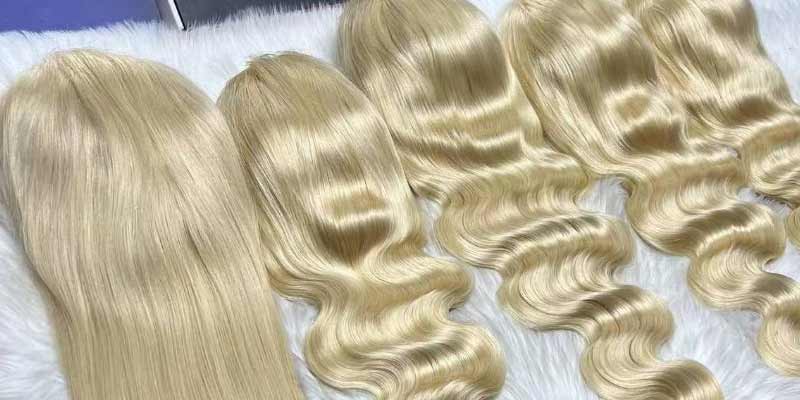
Pure, Uncolored, Healthy Donor Hair: The Colorist’s Canvas
This is the absolute top tier of the market. When the raw hair material is genuinely healthy, it means the factory took zero shortcuts during sourcing, carefully vetting the hair so that previously dyed material doesn’t slip through.
While “single donor” hair is still mostly a myth, premium factories keep the donor count strictly low to ensure all the mixed hair naturally shares an even shade of black—typically an off-black 1B or a natural Color 2. Because it is naturally pure and consistent, there is zero need for a factory color touch-up.
As a result, you get hair that bleaches cleanly and consistently to a #613 every single time. If you need to push it even lighter to a true #60 platinum, this hair can handle it. Because the bleach only has to lift natural pigment with no artificial hurdles, the hair retains its natural elasticity and achieves the maximum possible lifespan for light blonde hair—provided you actively maintain its moisture levels.
Our Orange Line is an exact example of this quality. It is sourced from pure Chinese donor hair. Because Chinese hair is naturally coarse and thick, it is incredibly resistant to chemical processing, making it withstand bleach much better than finer hair origins. It maintains maximum health even at a #613 or #60, making it the required choice if your business demands are extremely high and you need flawless, predictable hair for every single install.
The Testing Reality: How to Know What You Bought
But let’s face it, if you’re buying 2 bundles a month, you can’t bleach each bundle as a test of its quality. Because, the moment you put lightener on that hair, you own it. You cannot return a chemically processed bundle to a vendor.
But you still need some way to check for hidden dyes to make sure your vendor is sending you the consistent, natural color hair that you can confidently sell to your clients.
1. Visuals: Spotting 1B vs 1 Differences
Before you even order, and before you touch a chemical, start with the visuals. While looking at the hair won’t always give you a 100% definitive answer, it provides massive clues about the quality. Here is what to look for:
- The Price Tag: True donor hair typically sits around the $120 range for 30″ bundles (depending on fullness ratios, origin, and the vendor’s profit margins). Seeing a $70 price tag? That is processed floor hair pricing. Seeing $100? That strongly points to shortcut donor hair.
- The Follicle Check: Are there little white bulbs (follicles) attached to the strands? Think about it: if raw hair is actually cut directly from a donor’s ponytail, it physically cannot have roots attached.
- The Movement and Shine: Real human hair retains its natural structure and flows like actual hair. If the extensions are unnaturally shiny or overly silky, you’re more likely dealing with subpar hair.
- The 1B vs 1 Check: Do all of their natural black bundles look like a perfectly uniform, jet-black Color 1 with unnatural blue undertones? True natural color hair usually falls into the off-black 1B category, showing slight variations in shade and natural warm undertones.
- The Ends: Do the ends look healthy, or are they frizzy and thus damaged? Did the vendor bluntly chop the ends straight across? Blunt cuts can increase the look of fullness, but they also hide the true ends.
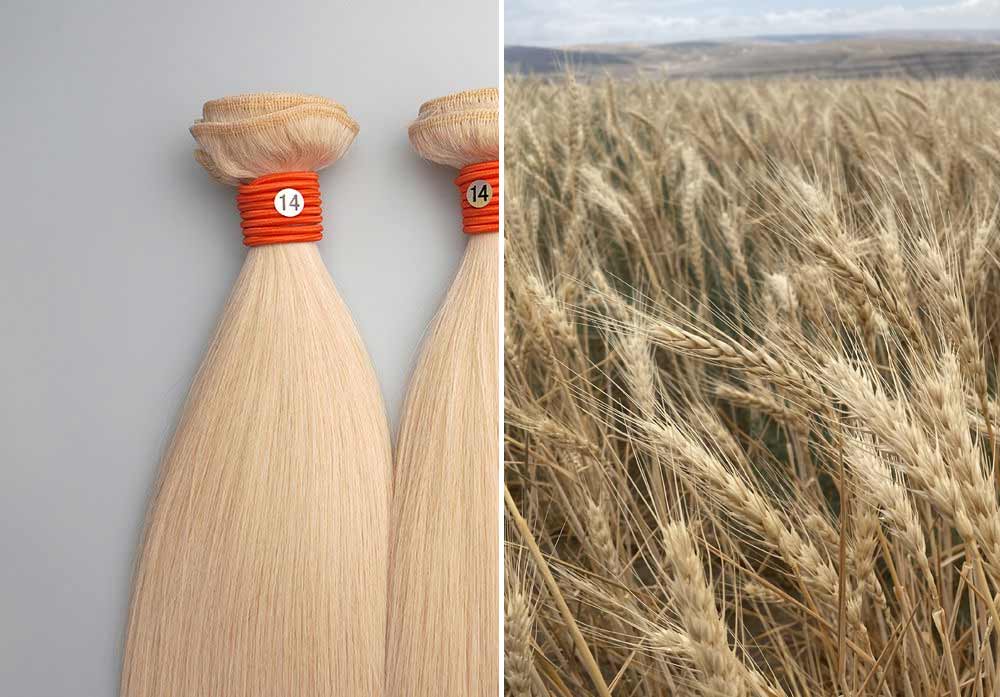
- The #613 Bundles: Look at their pre-bleached blonde straight bundles. Do they have a brassy, yellowish-golden tint? High-quality #613 hair should have a clean, matte, wheat-like appearance. If the factory can’t get it there, then you probably can’t either. It’s often limited by the quality of the hair material, incompetence, or applying high heat.
2. The Acetone Test: Identifying Dyed Hair
When people talk about testing hair for color, they often mention the clarifying shampoo test. But not only are you altering (washing) the hair and instantly making it non-refundable, clarifying shampoo is only strong enough to catch heavy, leaking dyes. It is highly unlikely to catch the subtle factory touch-ups.
Then there is the scraping test—a method I actually made popular about six years ago, although it often got misunderstood and rebranded as the “cuticle test.” The old logic was: if it scrapes white, it’s raw hair; any other color, and it’s dyed. Except, I recently made a video showing exactly why this gives false positives. I demonstrated how you can scrape completely natural, uncolored hair and still produce a brown powder. It is simply unreliable. (You can check that video out here).
If you want 100% certainty on whether your 1B hair extensions are actually natural vs processed hair, the undisputed king is the hair dye acetone test.
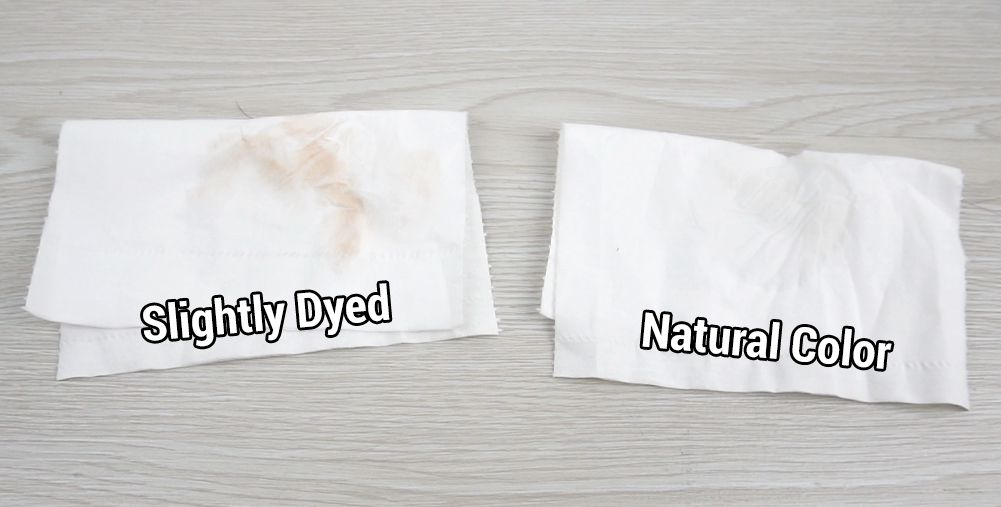
It is quick, literally takes 20 seconds, and it doesn’t alter the hair. That means you can test a bundle from any batch and, if it fails, still safely get your refund. It is the ultimate way to safeguard your consistency. You simply take a strong white tissue, soak it in pure acetone, and rub a small section of the hair strand. Acetone immediately strips artificial dye, including very light traces. If the tissue turns brown, the hair is dyed.
(You can find a full breakdown of this in our blog article here, and a video demonstration on our YouTube channel).
The Washing Test: Verifying Natural vs Processed Hair
While the acetone test checks for dye, you still need to verify the hair’s health. There are usually visual signs of damage, but factories often cover these up through careful post-processing—like bluntly cutting off split ends or using products that temporarily mask the hair’s true condition.
After 9 or 10 years of daily, hands-on experience—handling kilograms of hair and testing hundreds of different vendors—I can usually tell a bundle’s quality just by handling it. But that is accumulated experience, and impossible to explain in an article.
What I can explain is the Washing Test, where you simply wash the hair and check how frizzy it is when it air-dries.
To understand why it works, you just need to understand porosity. Healthy hair has an intact cuticle, meaning it isn’t overly porous and naturally retains its moisture. So if you wash it, it stays smooth and has minimal frizz. Damaged hair—like the acid-washed floor hair factories dye to a jet-black Color 1—is highly porous. When you wash highly porous hair with a regular shampoo, it gets frizzy. The more damaged the hair is, the more it frizzes.
As previously explained, damage levels aren’t 100% consistent; they sit on a spectrum. When you wash the hair, you get a rough indication of exactly where on that spectrum it sits. While factory products might hide this damage straight out of the package, a simple wash removes that cover. True, healthy natural color hair shouldn’t get frizzy; it will simply air-dry smooth.
In short: the worse the underlying damage—whether from subpar raw sourcing or harsh acid-processing—the worse the resulting frizz will be.
The Bottom Line: Choosing the Right Hair for Your Goals
Now that you understand how sourcing, factory processing, and chemical limits actually work, it comes down to choosing the right hair for your specific business needs.
We don’t hide how our hair is sourced. Instead, we structure our inventory to give you the exact quality you are paying for, without the industry shortcuts. Here is exactly what to choose based on your budget and your bleaching goals:
The Black Line (1B): Maximum Affordability
If your clients just want an affordable install in a consistent off-black 1B and don’t care about bleaching, this is your go-to. This is standard processed floor hair, and we price it honestly. Just remember the chemical reality: if you do attempt to bleach it, respect the #27 color limit.
The Pink Line: Bleachability on a Budget
If you need an affordable option but still plan to lift the hair, the Pink Line is the smarter play. It is technically floor hair, but because it is kept much purer during factory processing, it can handle being bleached well. It gets you very close to a #613 without making you pay fake “premium” prices.
The Orange Line (Natural Color): The Premium Standard
If you need the absolute best premium quality for the Black women’s market, this is it. The Orange Line is pure, healthy natural color donor hair with zero sourcing shortcuts. Because it is naturally coarse and durable, it withstands processing beautifully, giving you consistent, healthy results for high-end custom wigs and installs.
The LUX Line: The Pinnacle of Blonde
If your ultimate goal is flawless #613 or #60 platinum—especially for salon methods—this is the highest tier we offer. For the LUX Line, the manufacturer hand-picks naturally lighter donor hair—specifically those Color 2 dark brown shades—right at the source. Because the hair starts lighter naturally, it doesn’t have to fight as hard during the bleaching process, guaranteeing the absolute healthiest blonde possible.
Our articles are designed to help you avoid bad purchases and save money. If you found our article interesting or useful, please share it with your friends who might benefit from this information. If you have any further questions, please don’t hesitate to contact us through the comments, iMessage/WhatsApp: +86 135 3369 3283, cristina@bossique.com, or DM us at www.facebook.com/bossique.