
Looking for the perfect curly hair extensions? It’s not just you; it’s genuinely tough to find the right match, especially because people have such different needs.
For many Black women, the quest is for curly hair bundles that perfectly echo the natural curl of their hair, achieving a seamless blend that feels authentically their own.
White women often face their own challenges, particularly when searching for long-lasting blonde curly hair extensions that maintain a vibrant, natural-looking shade over time.
This article dives deep into why finding the ideal curly hair extensions, whether it’s hair extensions for curly hair or specialized shades like blonde, can be so complex.
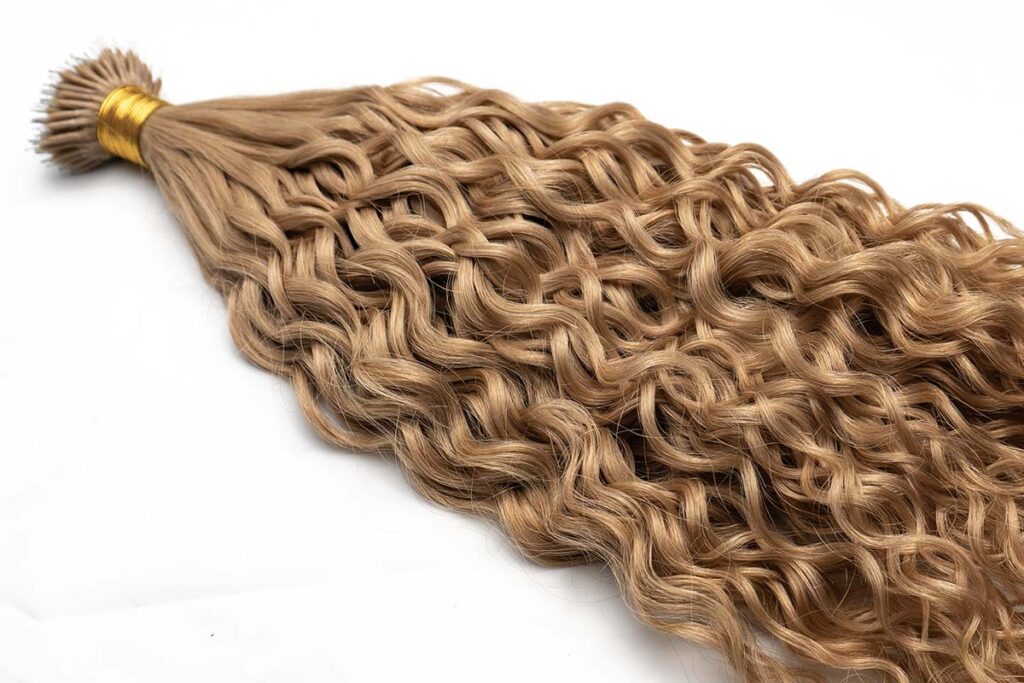
Table of Contents
1 – Raw Hair and Its Properties
Raw hair has intact and aligned cuticles. This type of hair typically comes from Asian donors and is coarser in structure compared to other hair types. Its structure is equivalent to that of a steel pipe, making it hard to bend. And that’s why the majority of the Asian population only grows straight hair.
That makes it particularly difficult to get hair with intact cuticles to hold a wave or a curl. For example, the following pictures are taken about 6 hours apart after applying a loose wave with heat.
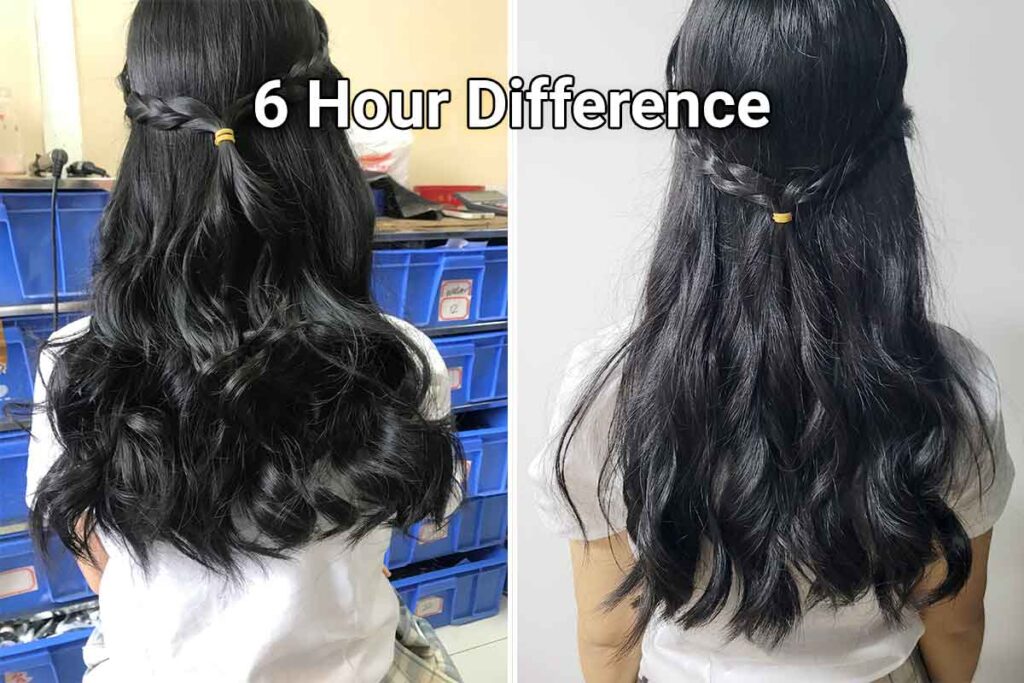
When applied with heat, I can’t get them to last a full day. But what about perming? Well, this picture was taken 2 days after I had it permed.

Not much of the texture is left. But it can be made better with some hair care tips, for example, applying curls when hair is a bit dirty (thus not freshly washed hair) and using hair spray to hold it better. It’s also possible with certain production standards, but we’ll come back to that and explain why there are downsides to those.
TIP: So, if you want to straighten raw hair extensions, you just have to spray them with some water and let them hang overnight.
2 – Understanding Cuticle Alignment and Hair Maintenance
When hair comes directly from a donor, it keeps its natural alignment from top to bottom, avoiding the need for chemical processing. This natural state makes it better than processed floor hair. But when you add curls to this straight hair, the cuticle changes direction to wrap around the curl, creating a full 360-degree pattern. This new direction in curly raw hair increases the potential for friction.
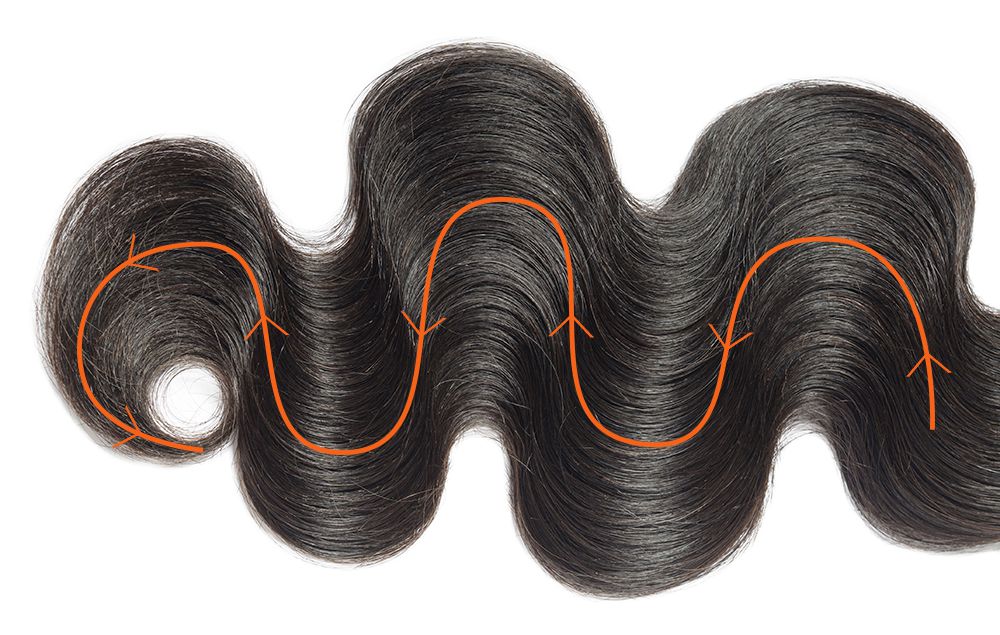
This increased friction among the hair strands leads to more tangling and makes the hair harder to manage. To mitigate this, many manufacturers remove some of the cuticles before creating curly hair extensions. This method isn’t just used for curls; it’s also common for styles with stronger waves than body wave or loose wave textures. Removing some cuticles helps reduce tangling and makes the hair easier to handle.
2.1 – High Quality with High Maintenance
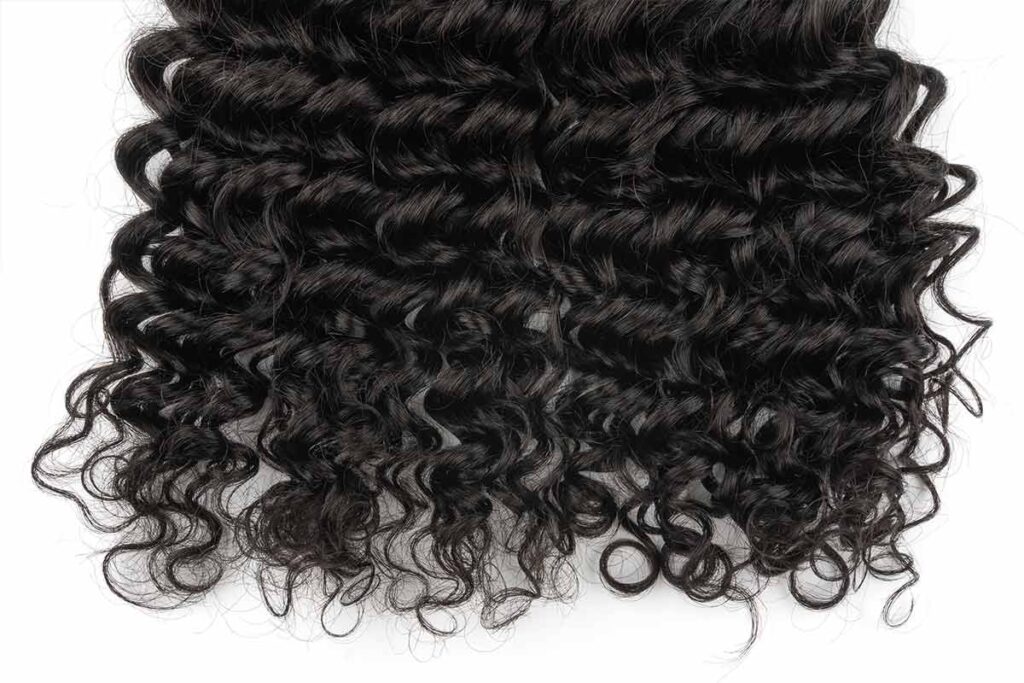
Manufacturers who prioritize high-quality curly hair extensions often only choose to strip a little bit of the cuticles. While this approach helps maintain the strength of the hair, it can lead to more tangling and requires extra attention.
To handle this, straightforward hair care practices can significantly help. Ensuring the hair stays moisturized, regularly using conditioners or other products that smooth the cuticles, and consistent brushing can all contribute to keeping the curls looking good and manageable.
If you’re thinking about wearing these best human hair bundles or even selling them, it’s a good idea to try them out yourself first. This way, you can understand what daily care they need and share these tips with your clients. Letting them know about potential issues and how to handle them will help them keep their extensions looking great.
2.2 – Lower Quality with Easier Maintenance
On the other hand, some manufacturers choose to remove more of the cuticles from the hair to make it easier to manage. This results in less tangling and simpler daily care, reducing the time and effort clients need to spend on maintenance.
But this approach can lower the hair’s overall quality and make it more likely to get damaged as time goes on. While this means fewer complaints from people who want hair that’s easy to manage, it also means the hair isn’t as high quality as it could be.
2.3 – The Delicate Balance
It’s difficult to find the perfect curly hair extensions because every buyer has different needs and hair care routines. Manufacturers often have to choose between making extensions that are easy to maintain or focusing on keeping the hair’s natural quality. Both choices attract different types of customers.
If people don’t know how to deal with tangles, you might make things worse by roughly combing through knots, leading to significant breakage. In these cases, it might be more practical to choose lower-quality, easier-to-maintain human hair extensions.
On the other hand, those who are willing and able to invest more time and effort into their hair care can benefit from higher-quality extensions that, while requiring more maintenance, offer better longevity.
Providing clear instructions and detailed information about how to care for the extensions can help buyers make better choices based on their personal hair care routines and preferences. This ongoing balance between making hair extensions that are easy to use and maintaining their quality is what makes finding the perfect curly hair extensions especially difficult.
3 – Color Matching in Hair Extensions
As previously mentioned, Asian hair is quite coarse and has difficulty maintaining a curl. In production, straight hair can generally be textured by perming hair and using steam styling.
Light perms often fade quickly. In contrast, stronger perms tend to last much longer, but they can have a downside, such as the distinctive corn-chip smell associated with brands like KBL Hair.
Steam styling is the alternative method to add texture to hair. Low heat doesn’t produce long-lasting curls. The application of high heat is crucial for setting curls in coarser hair types. However, one massive downside of high heat is that it discolors hair. For example, 613 blonde bundles will easily turn to a darker golden shade of hair when the heat is turned up, as you can see in the picture.
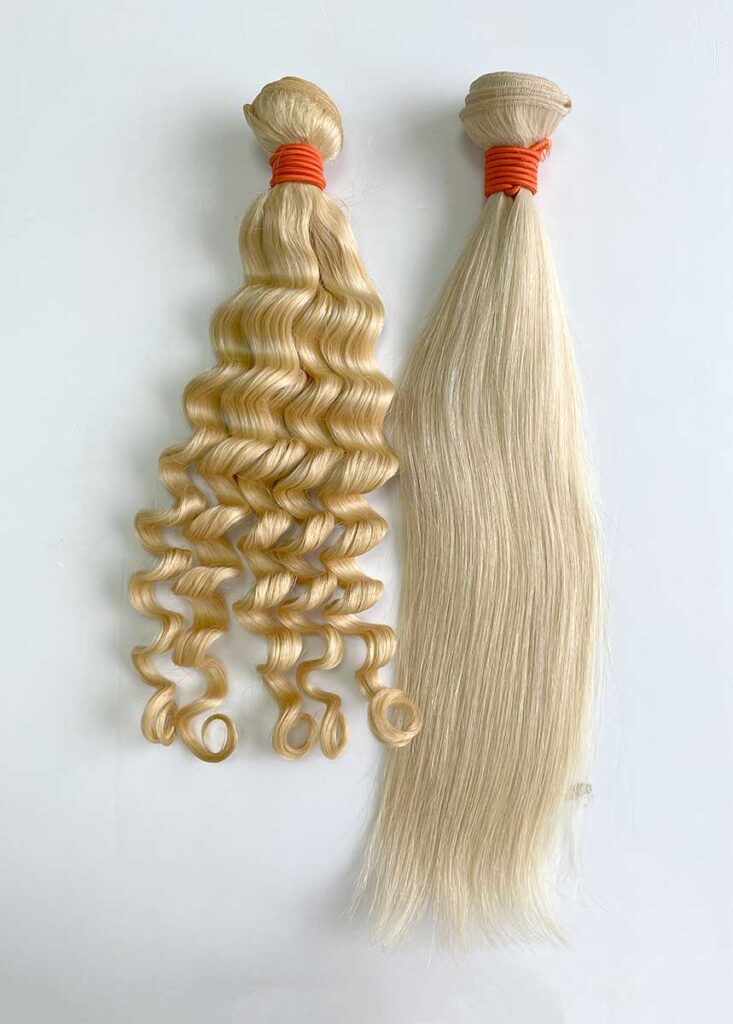
So, hair manufacturers face a tough choice: use less heat and risk curls that do not last, or apply more heat and compromise on color fidelity. Many manufacturers will turn the heat down to minimize discoloration.
Our [Orange Line] hair is quite coarse in texture, and that means we have to use really high heat. That’s also why we only offer the 613 blonde in straight, as other textures come with too much discoloration.
However, our regular [LUX Quality] hair extensions are made with slightly finer hair material, as they’re supposed to match white women’s hair, which is significantly less coarse than Chinese women’s hair. It makes it slightly easier for the blonde curly hair extensions to hold a curl and thus will have less discoloration.
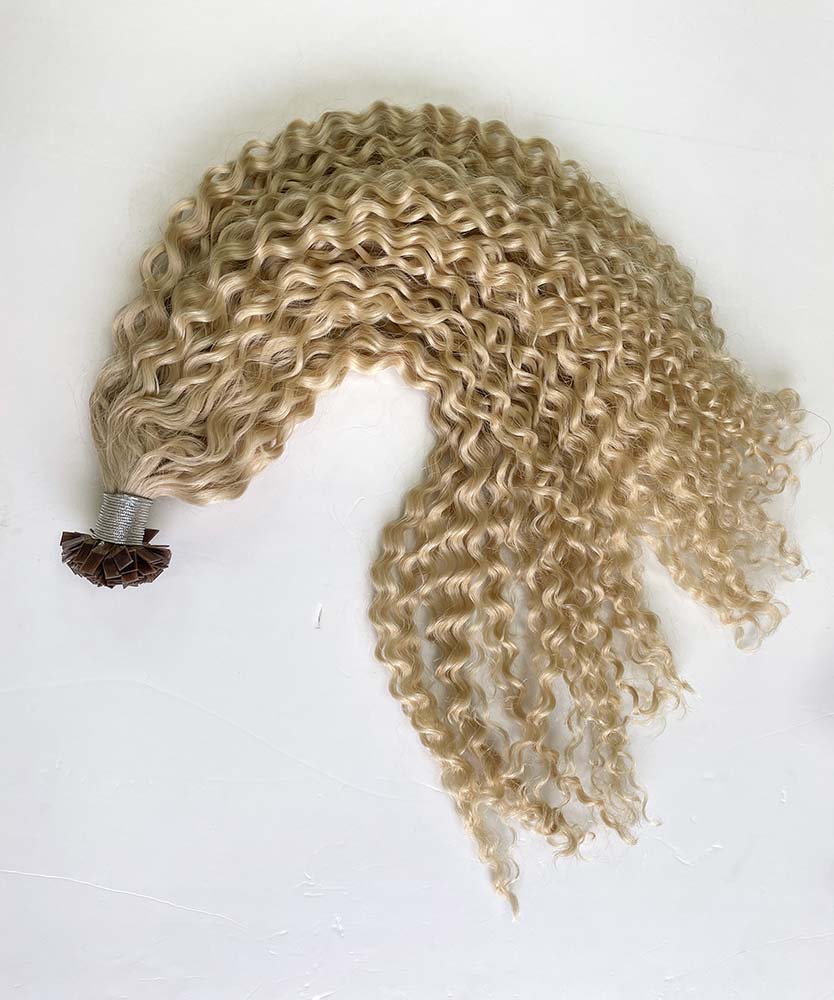
But with that in mind, you’ll always have some change in color, making it very difficult to match the color ring. And that makes curly hair extensions a quick source of complaints. Either the curls don’t last, or the colors don’t match.
And that’s also another reason why you should minimize heat on your colored hair extensions. Not only does it damage hair, but they’re also easy to cause discoloration on hair extensions.
4 – Matching Curly Hair Extensions to Specific Curl Types
Creating consistent curly hair extensions to match specific curl types (3C, 4A, 4B, 4C) isn’t easy.
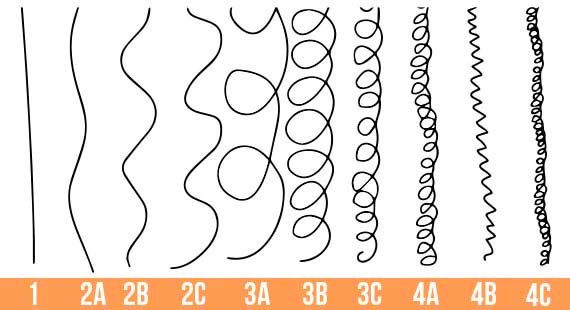
Curls come in different sizes and patterns, and achieving these looks with steam styling requires precise techniques. The hair is wrapped around rods of various sizes before being steam-styled. For example, you can see how loose wave texture textures are made by watching the following video.
Tighter curls require even more work. Check out the production of a kinky curly texture bundle in this video:
When steam-styling hair, the final texture can be influenced by various factors, such as the specific temperature and duration of the process. The quality of the hair is also important. Hair with intact and aligned cuticles tends to result in a looser texture compared to processed hair with stripped cuticles.
When we send our orange line bundles with fully intact cuticles to the texture studio, the coarse nature and intact cuticles often result in looser curls than we want. That’s why we don’t offer 3C, 4A, 4B, and 4C textures; we can’t achieve the level of accuracy we need.
Even the tension used during wrapping affects how tight the curl will be. These factors make it challenging to consistently produce extensions that perfectly match a specific curl type.
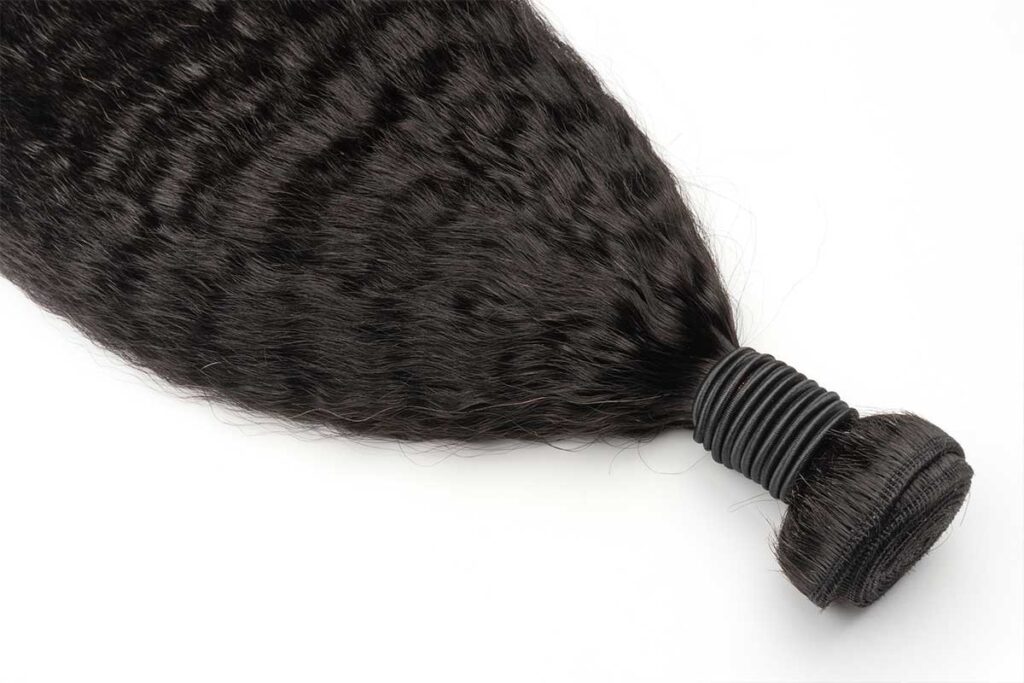
In conclusion, when you add curls to hair, it changes the cuticles’ relative direction, which can lead to more tangling. This issue can be addressed by removing some of the cuticles. However, doing so may reduce the hair’s overall quality.
Manufacturers and buyers face a choice: remove fewer cuticles for higher quality but more maintenance, or remove more for easier care but lower quality. This decision is important for finding hair extensions that not only meet stylistic desires but also suit practical daily needs.
Additionally, using high heat to create long-lasting curls can alter the hair’s color, making it difficult to match curly hair extensions with the desired shade. Often, a stylist is needed to correct this, but the process might further straighten the hair.
Our articles are designed to help you avoid bad purchases and save money. If you’ve found them useful and wish to support us, please consider a small donation. Your contributions will help us purchase better equipment, like a new camera, or even just a milk tea to keep us going! Thank you for your support!
Thank you for taking the time to read this article. If you have any questions or want to learn more about the topic, please don’t hesitate to contact me at +86 135 3369 3283 (WhatsApp/iMessage). If you find this information helpful, please share it with your friends and family on Facebook. Together, we can spread knowledge and empower others to make informed decisions.
Frequently Asked Questions
What Are 3C, 4A, 4B and 4C Hair Types?
3C Hair: Tight coils, lots of volume, and a distinct S or Z-curve shape, often overlooked in hair typing systems.
4A Hair: Known for tight coils that can easily dehydrate. Maintenance requires rich, natural emollients.
4B Hair: Forms sharp Z-shaped angles instead of coils, varying from fine to coarse. Benefits from oil treatments before shampooing.
4C Hair: Similar to 4B but with less definition and more shrinkage, extremely delicate, and requires protective styling and moisturizing humectants.
1 thought on “Why You Can’t Find the Perfect Curly Hair Extensions!”
Comments are closed.